Sunday, May 8, 2011

How to fix the meaning of a technical term, whose prehistory is unknown?

Ritual terminology has been fundamental in influencing the later development of philosophical terms in India. Several ritual terms have a textual origin (e.g., tantra 'warp', tati, from the root tan-, `to expand') and most of them are transparent (i.e., they can be analysed as derived from a certain root and a certain suffix). However, one has often the problem that such analyses are later than the terms themselves. Moreover, all these terms have frequently a pre-history we are not aware of, which might have influenced their historical meaning in an unpredictable way. Consider the case of tati and the following explanation in Gonda 1977, 510:
[…] pūrvā tatiḥ and uttarā tatiḥ "the antecedent and the subsequent series of ceremonies". The standard (ritual) is pūrva tatiḥ, and what one arranges (modifies) is uttarā tatiḥ; (for instance,) the establishment of the ritual fires is pūrvā tatiḥ, the re-establishment uttarā tatiḥ; of the vegetarian sacrifices (iṣṭi) the full and new moon sacrifices are the pūrvā tatiḥ, all the optional rites (kāmyā iṣṭayaḥ) the uttarā tatiḥ.
This seems to frame the uttara tati/pūrva tati distinction within the prakṛti/vikṛti one.

Further posts on Ritual Sūtras and on their world view: this one on the spatial arrangement of sacrifices; this one on tantra.

Saturday, May 7, 2011

Which sources for Indian philosophy?

In our investigations of Indian philosophy, we can count on four kinds of sources:
  1. 1. Indian philosophical texts: this is the soundest and most direct way. However, life is short and the texts to be read are many. Hence, what shoud one read? And what should one start with? If one only counts on what one knows, one ends up overestimating the importance of the authors one happened to read first…
  2. 2. Indian doxographies: these are still insider sources and can give us a good sense of what was going on in the Indian philosophical debate. However, their authors had an own agenda (for instance, showing the superiority of Advaita Vedānta) and did not necessarily aim at an "objective" depiction of their opponents' views.
  3. 3. "Western" textbooks: these are outsiders, both from the temporal and the cultural point of view, even if they have been written by Indian philosophers, such as S. Radhakrishnan and M. Hiriyanna. According to the case, they might be very useful, but conditioned by their authors' agenda (e.g., Radhakrishnan) or by their being outsiders.
  4. 4. Debates represented in the Indian philosophical texts themselves: these can give us a lively picture of what was really important in the Indian philosophical stage, but some authors might be very inaccurate in reproducing their opponents' views, hence, choosing the right source is still a key-issue.

In my experience, I would highly recommend the study of Jayanta Bhaṭṭa's philosophical masterpiece, the Nyāyamañjarī. I will dedicate to its linguistic chapters some future posts.

Jayanta is one of my favourite authors and I posted a lot about him. You might wish to see this post (fortune of the NM), this one (exhortative function of language as explained in the NM), this one (another work by Jayanta), this one (Indian linguistics in the NM) and this one (on cognition and action).

Friday, May 6, 2011

Identifying opponents

If you work on philosophical texts in Sanskrit, you will constantly have to face the problem of how to distinguish between opponents and upholders of views shared by the author. Often we can count on elements such as "it must be said" (ucyate), marking the beginning of a reply to a view one does not share, or nanu, iti cet, identifying opponents.
But what if they are all lacking? For the time being, I have not been able to identify any hierarchy between the pronouns used to introduce discussants, such as kecit, apare, anye. Today, thanks to a friend (M.Ferrante), I could read a page of Ashok Aklujkar's unpublished dissertation The Philosophy of Bharatṛhari's Trikāṇdī (Cambridge, Mass.,1970), where Aklujar writes that in Bhartṛhari (§0.7):

In the statements of those views which he can be said to accept on some level or another, either fully or in part, the word apara "someone else" is of common occurrence. It seems to have the same connotation for him which the word para has for Nāgeśa. As Helārāja [in his commentary to Bhartṛhari] puts it "The word apara is a reference to scholars who hold the same view". On the other hand, the view stated with kecit, kaiścit, or keṣāñcit "certain persons," more often than not, turn out to be either unacceptable to Bhartṛhari or acceptable only with qualifications, as Helārāja often observes.
Aklujkar himself says that this is an "interesting peculiarity" of Bhartṛhari, and adds some caution:

In this connection, I must emphasize that I have not been able to find out the exact conditions under which apara and kim+cit posses the described connotations, and that I do not ascribe a view to Bhartṛhari merely because the word apara figures in its statements. I also wish to draw attention to the fact that the other two words, eka "one" and anya "another," which Bhartṛhari uses in starting various views do not seem to possess any comparable connotations.


Did readers notice similar hierarchical patterns in Indian authors?

On Sanskrit syntax and objections, see here.

Thursday, May 5, 2011

Where is the boundary between Brāhmaṇas and Śrauta Sūtras?

While reading the Vedic Saṃhitās, the Brāhmaṇas and the Śrauta Sūtras, I (probably not alone) have the feeling of shifting from one genre to the other, from one way of thinking to the other, with hardly any connection, apart from that of the common topic, i.e., ritual.
The shift could be explained historically, but I am inclined to suspect of our tendency to organize differences along a chronological grid. I would prefer to adopt along with it also a genre-distinction. It is possible that the genres evolved one after the other, so that their beginning is chronologically identifiable, although texts belonging to all genres have then been composed at the same time.
Can one still detect the transition from one genre to the other? Consider the following quote from Jan Gonda, The ritual sūtras, 1977: 515-6:
Especially the last chapters (praśna) of the [Baudhāyana] Śrautasūtra […] are something between a brāhmaṇa and a sūtra because the motivation of the prescripts is so often added. Among the explanations are many myths, part of them unknown from other sources. […] It is in perfect harmony with the character of this work that its author has not aimed at the well-known brevity and conciseness of the sūtra style. On the contrary, cases of repetition (also of longer passages), prolixity and diffuseness are far from rare. The several rites are dealt with independently. Verbs are often repeated, implications avoided; the phrases are as a rule long and the syntax is free.
Another remarkable feature is the structure of the work […]. Whereas the different opinions of other authorities are in the other sūtras subjoined to the several views of the author and consequently dispersed over the text the compiler of the Baudhāyana-Sūtra has brought all this controversial matter together in the four chapters XX-XXIII, the so-called dvaidha-sūtra ("on variant or different opinions").
I think that this specific place for all controversial topics may derive from the Brāhmaṇa structure, where controversies where altogether absent, influenced by the dialectical style of the Kalpa Sūtras, which demands that one deals with controversial points. In fact, Gonda himself follows (p.516):

After this part of the book there follows, closely connected with the dvaidhasūtra, the so-called karmāntasūtra (XXIV-XXVI) which countains pariśiṣṭas (i.e. paraliomena, topics that were not sufficiently explained in the preceding chapters). Caland had good reasons for supposing that the dvaidha- as well as the karmāntasūtra are additions of material that, through dating back to the same period as the main text, was drawn up somewhat later, perhaps by a pupil.

Wednesday, May 4, 2011

What does "South Asian Studies" mean?

Is "South Asian studies" only the politically correct version of what was previously known as "Indology", i.e., the study of Classical India?
One might think so, if one considers the names of several journals (such as the WZKS, literally "Vienna's Journal for the knowledge of South", or the Italian RiSS), research groups, etc. At most, the geographic label makes it possible to accept also contemporary studies about South Asia. But this is only true in contexts where Classical India is still the prevalent paradigm.
In the US, by contrast, the stress of the last decades on "Areal Studies" means that "South Asian studies" tends to mean just "the study of whatever counts and happenS in South Asia". You can see some evidence in favour of this view in the comments to this post, and I have now a further point to discuss.
As already mentioned, I just come back from Moscow, where I took part to a workshop called "Open Pages in South Asian Studies". In harmony with the first meaning of "South Asian studies" discussed above, there were several participants dealing just with Classical India, who all delivered their speeches in the first day. The second day was meant to be dedicated to Contemporary South Asia. Interestingly, speakers of the first group (including myself), expected a prosecution of the first day's trends, with papers dealing with Philosophy, Religion, History of Art, Linguistics, etc. This has been the case as regards Prof. Alexandra Safronova's speech on Theravāda Buddhism in Śrī Laṅkā. After that, we heard very interesting papers focusing on sociological and political topics, with no link at all with the cultural heritage of India (now meant in a cultural and not geographical sense).
Speakers of the first group enjoyed them, but I wonder whether the interest is bi-directional or not. Are scholars of (contemporary) South Asian studies interested in the background of what they study? Or do they prefer to read more about their topics (sociology, anthropology, politics, economics…)?

On this topic, see this post.

Tuesday, May 3, 2011

Castes and age-sex groups


What is at the origin of the varṇa system? Can we learn something about it through Indo-European comparisons? And how was the Indo-European society organised? How can we know something about the anthropological aspect of a lost society? Is it legitimate to use for this sake indirect reflexes in its successors? Or are not we always selecting the aspects we want to focus on?

I just came back from Moscow, where I took part to the interesting workshop "Open Pages in South Asian studies", hosted by the newly funded Centre for South Asian Studies of the University for Humanities and especially by Prof. Aleksandr Aleksandrovič Stoljarov (alias Alexander Stolyarov).
One of the papers, by Sergej Kullanda, focused on Aryan Prehistory and the Culture of Hindustan. The latter term might be misleading, but Kullanda used it in a merely geographical way, and his purpose was to reconstruct something about Indo-Iranians through their Indo-European background and viceversa. Kullanda has then been kind enough to give me an article of him (Kullanda 2002) about the so-called kinship terms (such as the antecedents of "mother", "father", "brother", "daughter") in Proto-Indo European (PIE). His main point, in both the speech and the article is that we can imagine a PIE society as organized according to age-sex groups instead of genealogical groups and/or castes. Consequently terms erroneously interpreted as expressing kinship are, instead, to be interpreted as referring to age-sex groups, with the terms later identified with the meaning "mother" originally referring to a mature woman, etc.
Accordingly, Kullanda imagines the PIE distinguishing between young/mature and women/men.
Within the Indian world, varṇas could also, Kullanda continues, be interpreted as age-sex groups, with warriors corresponding to the youngest ones, vaiśyas to mature people and Brahmans to senior ones. There is a widespread consensus that varṇas were not originally fix and inherited in Vedic times. Kullanda's hypothesis, however, changes the viewpoint insofar as it links it to age, instaead as linking it to professional skills.
Kullanda did not make the following point explicit, but in order for the society to survive, the "mature" age should last much longer than the other two, for vaiśyas are much more needed than warriors, at least in peace time.
Herodotus records a Scythian story saying that the first son of the Scythian progenitor became a priest, the second an agriculture and the third (i.e., the youngest) a warrior. Dumézil also states that the second part of life is linked to the middle class and the latter with the priestly class. But, apart from IE parallels, Kullanda has some internal (i.e., Vedic) evidence in favour of his theory, insofar as Indra and the Maruts seem to be the prototypical warriors, and they are said to be "young". Further, a passage of the Śatapatha Brāhmaṇa links, according to Kullanda, the first part of life with Indra, the second with Savitṛ and the third with Varuṇa. I am not completely convinced by this point, since the context is the ritual usage for some plates (kalāpa) and the passage says that with the first one the sacrificer acquires a first lot of life and so on, while at the same time linking them to the Deities mentioned above. Hence, the link between Deities and parts of life is indirect. This does not necessarily means that Kullanda is wrong, since his 2002 article makes clear that the age-sex organisation is very ancient between IE population. Hence, no wonder if only relics of it are present in the much later texts we know of.

Of course, one might object that many Deities in many contexts are said to be young and that being a warrior necessarily entails being strong (and, hence, not old)… The fact of seeing youth as a value seems to be very much present among various traditions and is by no means a IE specificity. Consequently, the present writer would suggest to Kullanda to add to his evidences a table of absences: which Deities are never qualified as "young"? Are they linked to the vaiśyas or to the Brahmans?


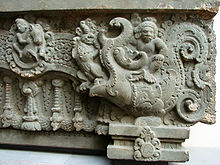
On PIE, see this post. Image: a later image of a Marut from Cambodge (musée Guimet, Paris).

Monday, May 2, 2011

Is there an alternative to state-funded research?


Entrepreneurial work is less likely to be possible in the case of humanities and philosophy. Still, apart from earnings, it is challenging to work and/or compete outside one's confort zone (which is likely to be the Academia). Since private citizens are often happy to read and visit exhibitions and are often unhappy with just their jobs and careers, would it be possible to make private-funded research possible also in these fields?

On this topic, see also this post.
If you think I am right, please consider donating here.
Licenza Creative Commons
Quest' opera è distribuita con licenza Creative Commons Attribuzione - Non commerciale - Non opere derivate 2.5 Italia.