Showing posts with label Jainism. Show all posts

Monday, January 27, 2014

जैनदर्शने किम् "प्रत्यक्षम्" इति ?

प्रचीनजैनदर्शने प्रमाणे द्विविधे, प्रत्यक्षम् परोक्षं च ।
प्रत्यक्षमित्युक्ते किम् ? अन्यदर्शनेषु इन्द्रियसम्यज्ज्ञानमिति । केषुचिद् योगिप्रत्यक्षं स्वसंवेदनं मनसाप्रत्यक्षमपि प्रत्यक्षेऽङ्गीक्रियन्ते । जैनदर्शने तु..... इह पठितव्यम् ।

Thursday, March 28, 2013

A(n Indian) world full of creatures: Gilles Tarabout on nature

From Hompi, Karṇataka
Is the world as we see it or not? Both in India and in the West, one has believed for centuries that this was not the case and that the world was full of living, though unperceivable, beings. The historian of philosophy Tullio Gregory writes that the space from earth to sky was believed —in the Western Middle Age— to be full of various kinds of angels, hierarchically ordered.

In Indian religious and popular culture (though not in the philosophical reflection, I am inclined to think, see here) one similarly sees that one believes and believed in a variety of intermediate beings occupying each inch of land, earth and sky. The anthropologist Gilles Tarabout underlined this aspect in (at least) two of his papers. In one of them, published in RiSS and dealing with astrology in Kerala, Tarabout refers of how astrologers consulted by the committee of a temple regularly describe the temple as full of presences, part of which may need to be pacified.

In his recent speech at the conference on The Human Person and Nature in Classical and Modern India, Tarabout has repeated how "No place is free of occupants". Thus, while building something new, one needs to pacify these powers, especially insofar as several of them may be malevolent or at least ambivalent. Among the former are listed bhūtas, pretas (which are described by Tarabout's informants as malevolent due to their untimely death) and are violent deities, whereas among the latter are yakṣīs which are dangerous female beings, honoured as goddesses and thought of as the spirits of unmarried dead girls. Only the serpent-deities may remain and most gardens in Kerala have a spot which is left wild and where nāgas are thought to dwell. In an interesting document of the Colonial time reported by Tarabout a spot of land is said to be sold together with cobras, the sky above, the underground with its treasures and the corresponding part of hell…

I guess that ancestors (pitṛs) would instead be counted among benevolent creatures. Do you have any evidence of the contrary?

Furthermore, this background assumptions partly explain also why non-theistic religions such as Buddhism and Jainism did not feel the need to deny the existence of nāgas, devas, and so on, and why monotheistic Indian religions acted in the same way: these beings were not the object of a specific faith but were just part of the description of the world as it is. Thus, they did not compete with the Buddha, the Jina, Viṣṇu, etc., for their believers' hearts.

For the program of the Rome conference on nature, see here. For my contribution to the conference, see here. For a further contribution to the conference, see here.

Monday, January 7, 2013

General rules regarding the re-use of texts (Part 1): Jain peculiarities?

During the last Coffee Break Meeting, we had some time to share ideas and compare results in our investigations on the re-use of texts in Indian śāstras. What do you think about the following points?

  1. 1) Almost everything is of foreign nature in the Objector (Pūrvapakṣa), whereas much more is the author's own voice in the Conclusive reply (Siddhānta) (I owe this point to Himal Trikha). I had the same feeling while reading Jinendrabuddhi's commentary on the Pramāṇasamuccaya. Is this only a Jaina-Buddhist practice? Did you ever find evidence of the opposite? 
  2. 2) What is typical of Jains, and why? Does the anekāntavāda lead to more quotations, more respect to the others and hence, acknowledgement, appreciative, value of the author? If the anekāntavāda plays no role in this respect, why is it the case that Jains preserve more manuscripts (and seem to have embedded more texts into their own)? Has this anything to do with the fact of living in a monastery, and —thus— having a library at disposal? Or with the minor emphasis on the absolute value of memorization and oral knowledge?
On the last Coffee Break Metting, see this post (for my introduction) and this wiki-page (for program, abstracts and other materials).

Wednesday, December 12, 2012

Call for Papers for an Indological Seminar

I have participated once to an Indological seminar (on absence) in Cagliari and greatly enjoyed the beautiful location, the great guest (Tiziana Pontillo) and the interesting discussions. Thus, I could not avoid publishing what follows:

 The University of Cagliari, Sardinia, will host an Indological Seminar in Cagliari, March 26 and 27, 2013. It will be the first official meeting of the Vrātya Project (focusing on alternative to the Brahmanical reform, in Jain, Buddhist and other texts; see here) and it is hoped that it will be a good opportunity for discussing the specific targets, the methodological framework and the selection of primary sources supposed useful for the planned research.

The sessions will start on Tuesday, March 26 at 9.00 and finish by 19.00 on Wednesday, March 27.
As far as the publication of the Proceedings is concerned, Participants are asked to kindly deliver their papers by June 15, 2013.

If you plan to participate, send an abstract (max 3000 characters) of your contribution by Tuesday, January 8, 2013, so that the pertinence of the proposed contribution can be evaluated in advance.

Everyone will be kept informed about the progress of her application, and about further necessary actions in time.

Kindly send your confirmation and the requested abstract to Tiziana Pontillo.

On the Vrātya project, see this post (containing also an appraisal of Dr. Pontillo), this post and this post.

Monday, October 29, 2012

Fellowships on Ancient India


Are you working or willing to work on ascetics and kings in Vedic, Pāli Buddhism and Jaina sources? Or on anthropological and/or artistic sources on the same topic?

Then, consider advertising for the following fellowships.

Some practical information:
—Your constant presence on the island is not required.
—The fellowship will enable you to work in a great environment (I have already praised Tiziana Pontillo, the project's coordinator, here and the other post doc are interesting and charming people).
—You are not expected to know Italian. The working language will be English and you are expected to are fluent in it. (If you need assistence with the Italian application, please consider asking me or Dr. Tiziana Pontillo).
—You will need either a PhD or at least 2 years of research after the attainment of your MA degree.

For further detail on the project, see this post.

 
The competition for three annual Research Fellowships on the so-called "Vrātya
project" have just been officially announced on the Website of the University of Cagliari (Sardinia, Italy).

The deadline for submitting candidatures is November, the 15th, 2012.


For the relevant pieces of information, please refer to

1) http://unica2.unica.it/concorsi/index.php?page=assegni&bando=320
TRACES OF A HETERODOX CONCEPTION OF KINGSHIP IN ANCIENT, MEDIEVAL AND MODERN INDIA: VEDIC SOURCES
S.S.D. L-OR/18 INDOLOGIA E TIBETOLOGIA
SETTORE CONCORSUALE: 10/N3 - CULTURE DELL’ASIA CENTRALE E ORIENTALE


2) http://unica2.unica.it/concorsi/index.php?page=assegni&bando=318
TRACES OF A HETERODOX CONCEPTION OF KINGSHIP IN ANCIENT, MEDIEVAL AND MODERN INDIA: ICONOGRAPHIC DOCUMENTS
S.S.D. L-OR/16 Archeologia e storia dell'arte dell'India e dell’Asia
centrale
SETTORE CONCORSUALE: 10/N3 - CULTURE DELL’ASIA CENTRALE E ORIENTALE


3) http://unica2.unica.it/concorsi/index.php?page=assegni&bando=319
TRACES OF A HETERODOX CONCEPTION OF KINGSHIP IN ANCIENT, MEDIEVAL AND MODERN INDIA: ETHNOGRAPHIC AND ANTHROPOLOGICAL DOCUMENTS
S.S.D. M-DEA/01 DISCIPLINE DEMOETNOANTROPOLOGICHE
SETTORE CONCORSUALE: 11/A5 – SCIENZE DEMOETNOANTROPOLOGICHE

Further two five-months fellowships will be advertised in a close future.

Friday, October 19, 2012

“Traces of an Heterodox Concept of Kingship in Ancient, Medieval and Modern India: Conference Call

At the University of Cagliari, a three-years project on “Traces of an Heterodox Concept of Kingship in Ancient, Medieval and Modern India ” is now starting. The coordinator of the project is Tiziana Pontillo, who is not only an excellent scholar of Indian Grammar, Rhetorics and of the early India history, as mirrored in texts, but also an intelligent and open-minded scholar, always keen to learn, curious and well-disposed towards the others. She has organized two conferences to which I participated and both were a scientific success and also a very pleasant experience.

The University is planning to organize a short Seminar on this topic on March the 26th and 27th, 2013 and welcomes contribution on the main topics of the project (see immediately below an adaptation of T. Pontillo's presentation of it, with emphasis added by me). I can only add that Cagliari is a wonderful town and worth a visit anyway.

PRESENTATION OF THE PROJECT
This project mainly aims at singling out the possible traces of a “total social fact of an
agonistic type” (Mauss 1923-24) both in literary and iconographic sources and in the social
patterns and ritual practices of contemporary India, which are assumed to date back to the age preceding the well-known classic hierarchic system. Moreover, a crucial parallel target is to try to reconstruct the assumed ascetic and gnostic non-brahmanic pattern which might have been merely marginalized in Vedic and late Vedic Literature, by stigmatizing it with the name of vrātya.
The following are the main starting operational targets that this project aims at:

1. VEDIC AND LATE VEDIC SOURCES
We intend to widen the available collection of Vedic and Late Vedic occurrences which testify the existence of a system, whose model has already been adopted by Heesterman from 1962 onward (in particular through the new details and insights added by Falk from 1986 onward), in order to depict the “pre-classic” bloody sacrifices which were supposedly connected with conflictual and reciprocal relations. Special attention should also be paid to the alternative hypothesis according to which the supposed reform was the outcome of a clash between two distinct branches of the immigrant Indo-Āryan population (supposed on the basis of the two-wave theory by Parpola 1983), reconsidered in the light of the late-Vedic fresco recently painted by Bronkhorst 2007 and of the relevant criticisms especially arising from his innovative relative and absolute chronologies (see, e.g., Witzel 2009).
Furthermore we aim at inquiring into the origin of the late Vedic “contestation between brahmins with each other” highlighted, e.g., by Bailey 2011, verifying if it is connected with the opposition between the so-called śrotriyas, who, by the way, refuse any gift (see, e.g., Śatapatha-Brāhmaṇa XIII.4.3.14 and Śāṇkāyana-Śrauta-Sūtra XVI. 28-29) and the officiants who were used to accept and even solicit for donations.

2. PĀLI AND JAINA SOURCES
It also seems compulsory to extend an available preliminary collection of Pāli and Jaina occurrences into the context of this same project, testifying the existence of a kind of asceticism which partially matches with that emerging from the Atharvaveda-source on the Vrātya or with some Upaniṣadic passages. For instance, such formulas as “to become Brahman”, “to become god among gods” and “to have brought the Brahmacārya path to an end”, which are included both in Vedic Sources (Yajurveda Saṃhitās, Brāhmaṇas and Upaniṣads) and in the Bhāgavadgītā and in the Pāli Canon, might have hinted at a remote shared religious (and, as a consequence, social) scope of life and of meditation, before than the legitimation of being a brāhmaṇa switched from individual abilities, such as poetical and ritual prowess, to the lineage of birth (Falk 2001, p. 133).

3. EPIC, KĀVYA AND PURĀṆIC SOURCES
Furthermore, we have evaluated till now a small collection of Epic and Purāṇic occurrences, already at our disposal because of some previous inquiries, as possible pieces of evidence for an ephemeral compromise between the gṛhastha-path (as an output of the ancient cyclical sacrificial pattern) and the feared tapas-way, before the rising of the winning and lasting Brahmanical inclusivistic Varṇāśrama-system. In this context, for instance, particularly intriguing seems to be the case-study of the conversion ceremonies which Vaiṣṇava sources seem to hint at, if we assume that they can descend from ritual practices which preceded the so-called “Brahmanic reform” as a more recent
rearrangement. Furthermore we are eager to inquire into the figure of Kṛṣṇa as a very peculiar worshipped god, who, at the same time, plays the role of an important kingly warrior who might have been the leader of a vrāta (i.e., a sort of Männerbund), considered to be the embodiment of a god by his followers. The so-called Brahmanic Reform might have transformed these relevant Cults, so that they result as inherently conforming to the orthodox Brahmanic religion, almost tuning the “low” tradition to the official one. In this context we think that it will be crucial to distinguish the peculiarities of the Early Śaiva and Vaiṣṇava Tamil bhakti 6th-12th c. CE, which is often confronted with Hinduism, Jainism and Buddhism in the Tamil tradition itself. In fact, this South-Indian Literature could be assumed as a possible repository for unorthodox speculative and religious features which seem to have been lost in the Indo-Āryan sources, as happened with regard to, e.g., some
Southern traditions of otherwise lost Vedic Schools (cf. Parpola 1984).
Furthermore, we propose to read some specific Kāvya-passages as the consequence of the well-known self-consciousness, so typical of the long and complex Indian tradition, which has interpreted and re-interpreted itself many times. In fact some authors such as Aśvaghoṣa might have tried to remind their listeners that their ancestors’ course of life and religious credo were closer, e.g., to the Buddha’s way, than they were aware of, while it was extremely distant from the contemporary Brāhmaṇa-oriented reform, in order to encourage a fresh relation between Buddhist- and Brāhmaṇic-dharma, based on a supposed shared past.

4. ARCHAEOLOGICAL AND ARTISTIC SOURCES
It is self-evident that any archaeological or artistic piece of evidence which can contribute to revealing the unorthodox kingly tradition and the marginalized non-Vedic asceticism is really intriguing for our purpose. Additionally a research program expressly devoted to creating a catalogue of all the features of the ‘feminine principle’ involved in the legitimation of kingly power seems to be likewise promising, especially in order to compare the Vedic data regarding the ritual context with the votive artistic production, such as the case study of Karṇāṭaka temples dating back to the IX-XIII c. CE (chalukya-hoysala style).

5. ETHNOGRAPHIC SOURCES AND ANTHROPOLOGICAL PATTERNS OF
RESEARCH
Since the first appearance of Frazer’s The Golden Bough, in 1890, which brought the case study of the Rex Nemorensis to the fore, this type of ascetic agonistic sovereignty became the leading theme for a cluster of researchers, such as J. Harrison, G. Murray and F. Cornford who made a particular effort to highlight a fierce ritual contest behind the framework of ancient Tragedy and Comedy. Later on, special attention was given, e.g., to the figure of Pelops, moving from Lidia to Greece, as the alleged prototype of the king-warrior, magician and god incarnate, tellingly coming from the “barbarian” Aswia. Consistently the notion of orientalism inaugurated by Said (1978) has recently been advocated, while linking the mystical tyrannical sovereignty model to the latter one (Munn 2006). In this field of research where the vrātya king has already been associated with the Teutonic Wotan-band (Heesterman 1957, 1985), papers on the sacred marriage, on the devadāsī institution, on the recurring marginalization of human beings declaring themselves “divine” in ancient Greece and Rome, and on the classical figures of pharmakeis such as Socrates would be of great help.
Shifting from issues of comparative purport to a strictly speaking Indian social reality, the inquiry into the extant jajmānī relationships will naturally play a crucial part in allowing the exploration of the possibility that they can be accounted for as a relic of a ‘non-reformed’ reality, i.e., a sacrificial system based on the symmetrical type of gift giving. Along with the figure of the funeral priest (mahābrāhman) accepting gifts in contexts of sacrificial violence (Parry 1980, 1994), unorthodox marriage alliances should be specifically focused on, by supposing that they mirror an apprehensive strong cultural autonomy with respect to the hindu asymmetrical gift of the virgin” (kānyādān), whose ideological (brahmanical) hallmark, as is well-known, is the institution of hypergamy, stressing inequality between wife-givers and wife-takers. Moreover, with regard to contemporary India, although the research is thus mainly oriented to investigating power relations which function within a kind of social cooperation imbued with a religious semantic which strongly defies all the
alleged socio-economic transformations that occurred during the colonial period and were strengthened by the green revolution, the seminar is not intended as an intellectual place where contributions attuned with the Marxist-Béteille line of investigation are to be dismissed. In this respect, a useful canvas for a seldom practiced dialogue might be provided by MacDougal’s article of 1980, where precisely the interaction between the dominant-caste and the reach-peasant models is precisely taken into account, by wondering whether they really are inspiring tools for everyday practice or are rather merely for theory-construction and comparative research.


PRACTICAL INFOS
Speakers will be assured local hospitality and, within the limits of the available funds, financial assistance will be provided to support their travel expenses.
The Proceedings  will be published.
For further information and for applying for the Seminar, please send an email to Dr. Tiziana Pontillo.

On Jainism and its connections with the prehistory of ascetics, see this post and this one (be sure to read the interesting comments). On Āgamas and antagonistic strands, see this post.

Wednesday, September 5, 2012

The Jaina heroic non-violence

Does one need to be breave in order to be non-violent? And is this an intrinsic connection or one due to historical reasons?


There has unquestionably been a ubiquitous connection in traditional South Asia between warrior and ascetic meditator, the conqueror of external enemies and the one who overcomes inner psychological foes. Jainism’s position as a religion of non-violence, which at the same time appealed to a warrior aristocracy throughout India up to the early centuries of the second millennium CE, need not then appear paradoxical, being most realistically explained by the central position within it of the quality, required by both ascetic and fighter, of intensely restrained control, and also by the promotion of a type of religio-political authority which in idealised form could encompass both the worldly and the soteriological (Paul Dundas, The non-violence of violence, in Religion and Violence in South Asia (Hinnells and King eds.), 2007, p. 52).


On Jainism and heorism, see this post.

Monday, September 3, 2012

Were Jainas non-Aryan? Or rather heroic Aryans?

Some scholars (e.g. Johannes Bronkhorst) interpret the early history of India along the lines of the conflict between a Vedic current and a śramaṇic one, which has been later attested in the writings of Buddhists and Jainas. Some among them interpret this opposition as an Aryan-non Aryan one (I tend to be sceptical about this interpretation, see this post). Others speak of various groups of Aryans, opposing each other, possibly because some had reached India before the others.

I recently read an interesting passage about the link between Jainas and the preceding Vedic background, showing an unexpected continuity between the two:

World renunciation of the sort followed by the Jains, Buddhists and other groups was an institution which entailed not so much the abandonment of social ties for a career of mendicant quietism as an entry into a heroic way of life which derived a great deal of its ethos, at least at its outset in the Ganges basin around the seventh or sixth centuries BCE,from an affinity with the early Indo-Āryan warrior brotherhoods, bands of young menwho at certain times of the year engaged in raiding, concomitant violence and the purificatory practice of celibacy.
The Mallas, whose name was traditionally perpetuated in the discipline at which Padmaprabha claimed to excel (cf. Sanskrit malla, ‘wrestler’),were in origin one such group, and both the Buddhist and Jain scriptures describe them ashonouring the remains of Mahāvīra and the Buddha, both members of the warrior (kṣatriya) class.

In this context, then, I would like to suggest that Jainism can profitably be regarded asexemplifying throughout its history what has been styled the ‘path of heroism’ (vīryamārga), a reconfiguration of warrior codes of bravery and physical control in the ascetic search for spiritual power and mastery (Paul Dundas, The non-violence of violence, in Hinnells and King, Religion and Violence in South Asia, pp. 40--41)

I wonder whether this last remark could apply also to Buddhist milieus?

On Aryan vs. non Aryans, see this post.

Saturday, September 1, 2012

Are (Jaina) women more able to control sexual instincts?

For Jainas, renunciation of sexual intercourses is of extreme importance. Not only is celibacy one of the 5 vows for a monk, even for lay people sexual intercourses are seen as a negative distraction from one's religious duties. Paul Dundas explains the gender-implication of this view:

Quite clearly this perspective on sexuality is thoroughly androcentric. Al-though concern is continually shown in the cheda sūtras for the chastity of nuns, the safeguarding and confirmation of this virtue is invariably the task of monks, and it can be concluded that celibacy has largely been presented within the Jain learned tradition in male terms (Paul Dundas, Sthūlabhadra's Lodgings, in Celibacy and Religious Tradition, p. 192).

So, what remains for nuns to be actively done?

In fact, their situation seems somehow similar to that of women in Western fairy tales and myths: although their male counterpart are the ones who are praised for their celibacy, and although some women are described as desperately craving for sex and most others as weak, nonetheless it is easy to find examples of average women who are less disturbed by sex in their regular activities:

women […], despite their supposed innate susceptibility to erotic passion,
are regarded as being capable to a far greater extent than males of controlling its influence through the regular performance of fasting.
[…] In these terms it is surely not accidental that there are many more Jain nuns than monks (pp. 192--193).

I am not sure I understand the last point. Does the author mean that it is easier for women to become nuns, given that it is easier for them to renounce their sexual life? And is anyone by chance aware of other reasons for the higher number of nuns (which is, by the way, also true in the Catholic Church and perhaps also in other religions)? (I would think of external reasons, such as the fact that becoming a nun has been, at least in some Christian countries, a way to escape from an undesired marriage).

On ascetism and celibacy in Jainism, see this post.
(photo from http://www.oldindianphotos.in)

Thursday, August 30, 2012

What is more difficult (for Jains and Buddhists): renunciation of sexual intercourse or of offspring?

What is the real renunciation at stake when Jaina and Buddhist ascetic movements propose celibacy as an alternative to the Vedic (and later smārta) approach to the stages of life? Is it more difficult to renounce sexual intercourses or one's role as a father (women are in a subordinate position and their case is studied along the lines of the men's one, as far as I understand)?

Renouncing sexual intercourses means renouncing to one of the main sources of pleasure and epic and narrative texts are full of instances of ascetics who loose everything (including their life in the case of Pāṇḍu) only because the temptation of sexual pleasure cannot be resisted. In the case of the king Pāṇḍu, which has been cursed to die as soon as he will have a sexual intercourse, the Mahābhārata narrative depicts him being fully aware of what is at stake, and nonetheless preferring this single instance of pleasure to a life devoid of it.

Nonetheless, the renounciation of offspring seems to me an even more fundamental threaten to the Vedic or smārta view of life. Jainas are, in other words, more provocative when they explain that the whole saṃsāra has no value and, hence, perpetrating it in one's children seems wishing them bad.

A hint at the idea that the two issues can be separated can be found in the Jaina tradition:

Jain tradition contrasts theascetic regime prescribed by Mahāvīra, which included celibacy as one of thefive Great Vows, with that of the earlier teacher Pārśva who, supposedly livingin somewhat less corrupt times than his successor, had subsumed this requirement within abandonment of possessions on the grounds that his followers had not required sexual inactivity to be singled out specifically (Paul Dundas, Sthūlabhadra's Lodgings, in Celibacy and Religious Tradition, p.185).


Irrespective of its historical accuracy, this depiction seems to mean that the issue of not-having-offspring is connected with that of renouncing one's worldly status (in which sense children and wives are among one's possessions), whereas the renunciation of sexual pleasure might be a different issue.
Do you know of any other overt distinction of the two issues within the context of a condemnation of both in Jainism or in any other Indian milieu?

Saturday, June 30, 2012

Have Indian authors believed in their god?

Until a certain moment of time, possibly around the 800 AD, Indian philosophers seem not to display very much religious feelings in their works. They might be atheists (like early Mīmāṃsakas), or generally theists (like Uddyotakara, who has a creator Īśvara in his system) or transtheist (like the Jainas in this definition, since their Jinas go beyond the "common" gods) or just not speak a lot about the issue.

The situation seems to change a lot if we look at the cultural landscape of, e.g., 13th c. India. There, most if not all philosophers seem to have been genuine believers. They adored a God and wrote about their religious experiences. Why this change?

(I know, "religious feelings" is an ambiguous definition. But please bear with me; after all we all notice the difference between Rāmānuja and Vātsyāyana.)

  1. 1. Because the etiquette in the previous period was to keep one's religious experiences private. After all, even in the subsequent period, authors often tended to distinguish their religious works and their rational-argumentative ones.
  2. 2. Because the philosophical milieu of India before 800 AD (as a conventional date) was much more secular. Religion was wide-spread on a popular niveu (as can be seen by devotional texts such as the Purāṇas, and artistic manifestations), but much less so among philosophers. 
  3. 3. Because later philosophers had to admit religion in their texts due to the influence of the increased political or social (or economical) significance of religious groups.
  4. 4. Because the "religious feelings" of earlier authors were less "personalised". Earlier authors worshipped impersonal entities, like the pursuit of epistemic validity, or dharma (either in the Vedic or in the Buddhist or Jaina sense). The difference is only in the fact that these bear no personal names etc.
  5. 5. Because the opposition between these two periods is just ill-funded. I am biased by my education, etc. Just like one can be "religious" without worhipping a god (as in most Buddhist groups), it does not make sense to speak of a religious or not-religious attitude. But, if so, how to rephrase the contrast?

Any other proposal to interpret this phenomenon?

On different concepts of deities, see also this post.


Friday, June 29, 2012

Personal favourites from the last Coffee Break Conference


The third Coffee Break Conference has been, according to many participants, the best one. Because the organisers' group is getting closer and working together is now smoother, more enjoyable and fruitful.

The following extracts are some of the passages that stroke me more. Interestingly enough, several of them come from panels dealing with development studies or with issues far away from my own ones.

M.D. quoting the following statement about Jainism: "Jainism is not 'atheist' but 'transtheist', the jinas are beyond the gods whom one prays".

A.M. noting that "Acculturative processes are multidirectional" (e.g., when a king reaches a remote tribe, it is not just the tribe that gets "sanskritized", but also the official kingship which is "contaminated" by tribal elements).

B.B. and B.D.I. noting that "Information is constructed and not collected", even while using "objective" measurements such as quantitative measurements.

What is then the solution? The same authors suggest:  "Thus, show the entire process in the research work!"

What impressed you more in the last conferences you attended? Don't go through your notes, just say what comes first to your mind.

Tuesday, June 12, 2012

The 2012 Coffee Break Conference

The Study of Asia – between Antiquity and Modernity

Program of the Third Coffee Break Conference

University of Cagliari, 13–16 June 2012
Aula verde – Cittadella dei Musei

13 June, Wednesday
Opening of the Third Coffee Break Conference
• 08.30–09.00 Greetings
Kings of the Wild: Hints of Unorthodox Sovereignty in Ancient, Medieval, and Modern India
• 09.00–09.20 D. Cinellu Chairman’s Introduction
• 09.20–10.10 Danila Cinellu Kingship and “contra-kings”. Searching for some harmony in the Frazer-Hocartian debate
• 10.10–11.00 Moreno Dore The Vrātyakaṇḍa: a kind of Jaina asceticism in a Vedic garb?
• 11.00–11.20 Coffee Break
• 11.20–12.10 Elena Mucciarelli Goddesses and Fertility in the Vedic Period: looking for stratifications
• 12.10–13.00 Cristina Bignami Viṣṇuvardhana, the royal propaganda and the Goddess
• 13.00–14.00 Lunch Break
• 14.00–14.50 Ewa Dębicka-Borek Can the worship of Narasiṃha-mantra serve as a converting ceremony?
• 14.00–14.50 Arik Moran Pahari bhakti: towards a history of devotional Vaishnavism in the West Himalayas

An Indian old man advised a Western researcher: ask while you are walking. Discussion on Development Studies Methodologies• 15.40–16.00 B. Benedetti · P. Cagna Chairman’s Introduction
• 16.00–16.20 Coffee Break
• 16.20–17.10 Barbara Benedetti · Barbara D’Ippolito Conversation between boundaries: self-critical
reflections on field work
• 17.10–18.00 Valentina Prosperi Asking and Observing along the Way, Researching Migrant Informal Construction Workers in India


14 June, Thursday
Cybernetic Sources: The Historical Sciences in the Age of Digitization• 08.30–08.50 Mark Schneider Instead of an introduction: Some remarks on digitization with East-Asian writing
systems
• 08.50–09.40 Camillo A. Formigatti TEIandcatalogingSanskritmanuscripts
• 09.40–10.45 Vanja Štefanec Natural language processing in philological research
• 10.45–11.05 Coffee Break – Presentation of the CAESAR project by Vanja Štefanec


Anthropological interpretations: spaces and characters in the current Asian context
• 11.05–11.25 G. Tabacco Chairman’s Introduction
• 11.25–12.15 Gabriele de Seta The Noise Connection: Experimental Music in China as a Networked Subculture
• 12.15–13.05 Sehat Ihsan Shadiqin Adat in Gayonese Discourse and Practice: The Development of Ethnic Identity in Indonesia
• 13.05–13.55 Giacomo Tabacco Speaking of Success: Overwork, Malaises and Dreams among a Group of Javanese Factory Laborers
• 13.55–14.55 Lunch Break

Contemporary Issues in South Asian Religions
• 14.55–15.15 S. Bindi Chairman’s Introduction
• 15.15–16.05 Daniela Bevilacqua Do not ask about caste. If you love God, you belong to God
• 16.05–16.55 Serena Bindi “Nowadays Gods do not always help us”. Belief, skepticism and explanations for ritual’s failures in Garhwal
• 16.55–17.15 Coffee Break
• 17.15–18.05 Massimo Bon Pakistan, Secularism and Religion: a Semantic Dilemma

15 June, Friday
Translation Techniques in the Asiatic Cultures• 09.00–09.30 A. Keidan Chairman’s Introduction
• 09.30–10.20 Fanny Meunier Study of the different Tocharian versions of the Sanskrit Udānavarga: translation vs. adaptation?
• 10.20–11.10 Chiara Barbati Christian Middle Iranian Translations within the Syriac Tradition
• 11.10–11.40 Coffee Break
• 11.40–12.30 Daniele Cuneo Translation and/or/as Adaptation? The Tamil “version” of Daṇḍin’s Kāvyalakṣaṇa
• 12.30–13.20 Samira Nikooeeyan An Analysis of the Translation of Metaphors in Shakespeare’s Translated Sonnets

On the rationale of a coffee break conference, see this post. For some comments after the second CBC, see this post. This one is a post discussing ideas for future Coffee Break Conferences (ideas, speakers and organisers are any time welcome!). For further information on the Coffee Break Conferences, see here.

Friday, May 11, 2012

vastu on the epistemological and ontological level in Jayanta

vastu is often used in śāstric Sanskrit as a loose term meaning ‘object’ in a not necessarily concrete way. It has nothing of the intrinsic concreteness of a piṇḍa. Unlike artha (about which see this post), it is not linked to a linguistic expression and unlike artha it is necessarily epistemologically sound. Cf., for instance, in Jayanta's Nyāyamañjarī, the following statement by a Buddhist opponent, opposing vastu and artha, with the latter being much vaguer:

Thus, when conceptual cognitions, which lack contact with external entities (vastu), appear, people have the erroneous conception: “I have cognized an external object (artha), and I have taken action towards it, and I have obtained it”. This [erroneous conception] is not, in fact, based on determining [the conceptually cognized] as an [external] object (evaṃ bāhyavastusaṃsparśaśūnyeṣu vikalpeṣu samullasiteṣu ``bāhyo 'rtho mayā pratipannaḥ, tatra cāhaṃ pravṛttaḥ, sa ca mayā prāptaḥ" ity abhimāno bhavati laukikānām (NM 5, section 4.4, Kataoka2009c, p. 460, translation in Watson and Kataoka (in the proceedings of the apoha workshop, about which see this post)).

Or, similarly, at the end of the same section:

But [apohas] are different from [universals] in that the former are not real entities (vastu).
vastu is less vague than viṣaya, which might refer to each knowledge content, be it the content of an actual instance of cognition or also the sphere of application (like gocara) of a future or hypothetical one. In his polemics against the Buddhists on the existence of universals, vastu is used by the Buddhists and Jayanta with the same sense, although with a different referent. In fact, both agree that vastu is the real entity actually known during an act of valid cognition. However, they disagree as for its identification. For the Buddhists, only the ultimate particular, the svalakṣaṇa, is a vastu (i.e., only the svalakṣaṇa is the real object grasped by a valid act of cognition), whereas for Jayanta a vastu can also recur and be either an individual or a universal (see scheme below, section 4.2). Consequently, the vastu is intrinsically simple for the Buddhists, whereas it might be also complex for Jayanta (which on this point is following Kumārila). The following excerpt is from the Buddhist objector, who starts with a sarcastic remark about the multiform vastu upheld by realists such as Kumārila:

The same thing which is universal, is a particular, the same thing which is one, is many, the same thing which is perpetual, is impermanent, the same thing which exists does not exists: these are [just] the remainders of the Jains!
And even while it is being said, it is non-appropriate.
If you (Kumārila) say that there is no contradiction because [universal and particular] have been seen, [we reply that] it is not so, because they are not perceived as such |
In fact, it has been said that the eye-perception (netradhī) does not grasp an artha that recurs ||

Some pages later, Jayanta replies:

As for what has been said, namely that “It is illogical that in a single object (vastu) two contradictory aspects (rūpa) simultaneously occur”, that is also wrong. […]
Like the distinction of colours occurs in regard to a variegated [spot], |
in the same way, one also distinguishes similarities and differences because of the manifoldness of an object (vastu) ||
Hence, since one distinguishes similarities and differences in this non contradictory way, |
objects (vastu) must have a double nature, like in the opinion of the Bhaṭṭa (Kumārila) || 

vāstava is used in NM 5 when Jayanta replies to the Buddhist criticism of the universal (jāti). Whereas the Buddhist considered the universal as an unwarranted conceptualisation, Jayanta answers that it is real (vāstava):

Even at the first connection of the sense faculty [with its object] one understands the sameness [of two or more individuals] |
and [their] manifoldness. Hence, commonness and difference are both real ||

Thus, the universal is real, i.e., it belongs to the thing (vastu) itself. It does not, however, belong to the concrete individual (piṇḍa), in which it is rather present (vṛt-). The vastu is thus the real object, the one which is rightly ascertained through a correct use of our instruments of knowledge. To this vastu belong the aspects of individuality and universality, insofar as they can be ascertained through instruments of knowledge.


Do readers have different opinions about the usage of vastu in other authors?On artha in Jayanta, see this post. On the apoha workshop and Jayanta, see this post. On Jayanta in general, see this post.

Monday, May 10, 2010

Karman in Jainism

As regards karman and its ethical value, Buddhist authors, especially of the earlier schools, had to distinguish themselves from Jaina opponents. Jainas embed a very ancient theory of karman, which understands karman as a sort of substance. Accordingly, a past good or bad action inhere in one's soul just like powder on a greasy item. In order to attain liberation, one has to free oneself from such a material substance, which envelops the soul and obstructs its power.

This leads to a major problem: how can karman, a substance, inhere in the soul, which is also a substance? The problem of the link between soul and karman was easily solved in the "Hindū" schools, since karman was thought to inhere in the soul as an action or a quality; and in the Buddhist ones, since karman was considered to be the only reality. What about Jainas? The usual way out is metaphorical: Jaina texts speak of karman as powder adhering to a wet cloth, or as water getting into a boat through its leaks. Later on, the notion of karman as a substance pervading the universe and attracted to the souls (called jīva, lit. ``living'') through their actions (meaning most of all "movements''), arises. According to Akalaṅka (8th c.), the karman would not adhere to the soul, if it were not for the soul's passions, which make it "greasy'' and fit for the karman to adhere on it. These passions, and their greasiness, is burnt through ascetism. In this way, the karman produced by the actions of a monk is immediately consumed.

Since karman is a material substance, it has a gross reality. In this sense, it is easy to understand how the performance of a bodily action is the more relevant ethical issue. Only a bodily action counts and consists of a substance. On the other hand, the intention while performing the action is no substance and has, hence, no direct ethical significance. Mental acts are, in fact, acknowledged among ethical factors, but only whenever there is no corresponding bodily action. A typical example of a mental act bearing negative ethical consequences is the adherence to a false doctrine (i.e., non adherence to Jainism). When a bodily action follows, the mental intention to perform it is not taken into account, either because it is overseen or because it is considered as just the precondition of the succeeding bodily action. Counter-examples, where intention and action performed do not harmonise (e.g., one kills someone although one did not want it to happen) are considered extreme exceptions. In fact, Jaina are extremely careful and mindful in avoiding every injury even to the minutest and subtlest living being. Once one knows about the existence of such creatures, a lack of attention is itself tantamount to the preliminary part of the action to kill them. For instance, not straining water means that one is deliberately swallowing the tiny living beings living in it. Hence, unconscious actions can be said to be evil, because they are caused by non-mindfullness.

In fact, the main way to accumulate this obstructive karman is –according to Jainism– to perform violence against other living beings. Consequently, non-violence is the supreme imperative for the Jainas. By refraining from committing any kind of violent act, conscious or unconscious, one does not accumulate further karman. Praying, studying, meditating, as mental activities are not karman and, hence, do not lead to any further accumulation of karman.
(I am not a Jaina expert. I hope Jaina readers will bear with me).

Wednesday, February 24, 2010

Multiplist Ethics and Scholarly Etiquette

I just read a very interesting essay of Chakravarthi Ram-Prasad. It is the first (out of five) chapter of his newest book, Indian Philosophy and the Consequences of Knowledge: Themes in metaphysics, ethics and soteriology (Ashgate, Aldershot, 2007). It is a challenging essay, dealing with the proposal of multiplism in ethics. This is compatible with the Jaina theories of anekāntavāda, nayavāda and syādvāda, although Ram-Prasad is honest enough to admit that it is not sure that this a philologically sound interpretation of the Jaina material. Hence, Ram-Prasad (just like J.N. Mohanty and many others) reinterprets classical Indian philosophy to think further. And he does it in a field which is in bad need of new paradigms, that of the encounters with the other (or the Other? or others?). The Jaina/Ram-Prasadian approach has the benefit of non hypostatising the Other in her Otherness while at the same time not swallowing her. That is, in Ram-Prasad's intention, multiplism allows the other her space and freedom to be as she wishes (even to become closer to oneself). Furthermore, it promotes a friendly encounter with her/him since reality is inherently multiple and hence inter-related.

The only disadvantage of this thought-provoking essay is the lack of the Sanskrit texts Ram-Prasad refers to or translates, if only in the footnotes. I wondered whether I have been irritated by this absence just because this does not conform to the scholarly etiquette I am used to. But there is something more on top of that, that is, the absence of the Sanskrit text makes for the reader impossible to counter-check the arguments. Moreover, due to the semantics of Sanskrit, a translation is (even more than in other languages) no more than an interpretation. Hence, if there is no Sanskrit text available, one cannot prosecute further Ram-Prasad's enterprise of thinking along the lines of the Sanskrit tradition (of course, one could go to the library and check the Sanskrit texts, but often Ram-Prasad refers only to the page number of a certain edition –which is not the only available one– instead of referring to the inner partitions of the text).

Monday, February 8, 2010

But, after all, … reality is multifold (tò ón pollakōs légetai)!

Independent of its original meaning, the syādvāda theory and several other tenets of Jainism challenge today's attitude to Identity and Difference. I will not pause here on the possibility to just tolerate differences (e.g., through relativism) because I am afraid this attitude cannot really make place for the contribution these differences can offer to the world. On the other hand, the idea that there is only a legitimate view, no matter how liberal this is, has as result a significant impoverishment. This is not just a pity for the sake of ideo-diversity (which cannot be argued for as an end in itself), it is a pity because in this way we risk to miss the chance to understand reality, which is often much more complex than we would think (at least: until now it has always been the case that reality was much bigger, wider and more complex than our forefathers would have thought). The last two centuries have witnessed important changes, such as the discovery of the subconscious, that of the double nature of photones, that of the indecidibility of an electrone's position. This makes me think that the challenge of difference has to be taken seriously. It is possible that the quest for non-contradiction just does not hold. I am not saying that we should give up the attempt to think consistently, on the other hand, I think we should explore more possibilities (Jainism? Aristotle?) to think through what appears contradictory, without just pretending to explain it away. Differences may be here to stay.

Tuesday, December 1, 2009

Are there plants in India?

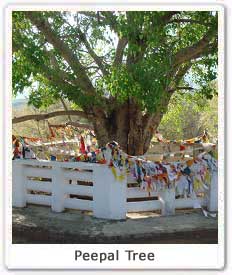
Could plants have been conceived by the Indian traditions in exactly the same way as in the (basically Western) contemporary world-view? The category of “plant may end up appearing less uncontroversial then initially assumed. On the one hand, “plants” do not constitute a coherent whole in Indian views; on the other hand, what we consider to be “plants” are not always sharply distinguished from what we would rather call “animals” or “matter”. By the way, one may note that similar problems arise even within the Western common understanding of plants, as soon as it is pushed towards less-common cases, such as see animals like corals (often considered to be plants, since they do not move), or phytoplancton (often considered to be made of animals –possibly because it moves through the oceans), not to speak about bacteria and micro-organisms. On a similar vein, we can detect extensions and inner partitions within what we would call “plants” in Indian traditions. First, in many texts (especially Vedic and early Jain ones) “plants” are seen as sentient, but only insofar as they are part of a cosmos which is in all its aspects not conceived as inert. In this case, plants are part of the same organic continuum embracing all elements of the universe and the universe itself as a whole. Second, in other texts plants (especially trees) are connected to Plant-Deities. The exact link between a plant and the Deity inhabiting it is not easy to ascertain, especially because one has to understand it out of narrative or religious texts which only incidentally deal with the issue. The Deity seems often to be conceived as inseparable from the tree, although in other (later?) cases it is said to be able to leave the plant and move into another one. In any case, it cannot live out of a plant, but for such short shifts. In some (again, later?) cases, Deities are said to have limbs, children and so on, and seem, hence, to be conceived in an anthropomorphic way. One wonders whether –at a stage which can only be inferred out of the texts preserved– the plants inhabited by a Deity were themselves thought of as Deities, or as Deities' bodies and not just Deities' abodes. Third, “plants” are not equal: almost all texts (until contemporary ones) take for granted the higher status of trees (often called vanaspati) among “plants”. Both phytotherapy and contemporary actions in favour of plants focus on the preservation of trees. From a different point of view, the more generative parts of plants (seeds, sprouts, blossoms, etc.) are deemed to deserve a greater respect, this time in Jain and Early Buddhist texts. Lastly, in many philosophical texts one witnesses a sort of “rationalistic” attitude against the evidence in favour of the sentience of plants found in Dharmaśāstra and/or narrative texts. While reading such philosophical texts one sometimes gets the impression that they are reacting against a popular belief. Thus, from their point of view they are proposing a neutral, rationale view against a folkloristic one. A Prābhākara Mīmāṃsā primer (Rāmānujācārya's Tantrarahasya), for instance, counts plants as living beings, but excludes them –overtly dissenting from some Manusmṛti quotations– from the possibility of fruition (bhoga) and, hence, from the reign of karman-bound creatures. Later Buddhist texts even state that plants do not live and classify them on the same level of earth, rocks, etc.

Tuesday, November 24, 2009

Jainism and nature


Paul Dundas wrote an illuminating essay (The Limits of a Jain Environmental Ethic, in Jainism and Ecology: Nonviolence in the Web of Life, ed. by Christopher Key Chapple, Cambridge Mass. 2002) warning about the risk to overestimate the 'ecological' commitment of Jainism and inspiring the following considerations of mine:
1. True, Jainists endorse ahiṃsā and include plants among living beings, but they do not share our contemporary concern for 'nature' as a whole. They focus on suffering individuals, and would not share our care for protecting a natural environment even at the expenses of some individuals living in it (for instance, we might decide to kill all wild dogs in the area of Canberra in order to preserve the Australian original habitat).
2. Nature (and even the sum of the individuals inhabiting it) is not something to be preserved in itself. One should strive for ahiṃsā in order not to accumulate new karman, not (only) for the sake of plants and microscopic organisms.
3. Points 1-2 entail no ethic evaluation. Ecology is part of the contemporary world view but the fact that we feel immediately close to it does not necessarily entail that it is the 'right' way to look at nature. In fact, the last century has –notwithstanding ecology– destroyed the natural world much more than the preceding eras.
(In the photograph: Jains avoid to swallow insects and other microscopic organisms by wearing these masks)

Sunday, November 22, 2009

Two trends in Indian arguments in favour of plants


There seems to be two different trends in Indian arguments in favour of plants.
1. On the one hand, some schools considered plants as simple living beings and, hence, respected them. For these schools, it is not uncontroversial that plants have a sort of basic awareness and that they take part to the cycle of karman. Jainism is the more consistent in arguing for the living status of plants. Early Buddhism may have included plants among living beings, but it is not clear whether only because of a general costume (and later Buddhism explicitly considers plants as just 'things'). 'Orthodox' schools of the so-called Hinduism are, again divided into two: epics and literature seem not only to argue for the sentience of plants, but to take it as self-evident, whereas philosophical schools usually deny it and interpret these passages as metaphorical.
2. On the other hand, plants are not only regarded as either insentient things or as simple living beings: in many cases we witness instances of plants being regarded as noble living beings, to be honoured and respected. This may have to do with the idea that plants are inhabited by divinities, but I sense that this is only a later, rationale, explanation of a primordial respect towards plants. Mahendra Kumar Mishra kindly made me aware of a paper of him about tribal ideas about nature, which by and large go in this direction. I am not daring to conclude that the 'Hindu' respect for plants as noble beings derives from a tribal concept of plants (nor do I believe in a 'uniform' tribal worldview, unchanged throughout centuries). I would rather propose that a 'lateral' (=non mainstream) notion of plants as noble beings has been preserved in some tribal milieus. Whatever the case, the appraisal of plants, even within those who acknowledged them as living beings, is highly differentiated.
Licenza Creative Commons
Quest' opera è distribuita con licenza Creative Commons Attribuzione - Non commerciale - Non opere derivate 2.5 Italia.