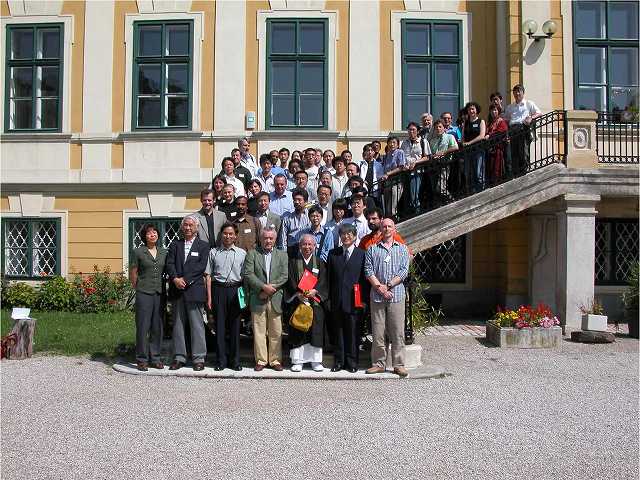
Wednesday, August 21, 2013

Dharmakīrti Conference

the 4th conference in Vienna, from Kei's blog
The 5th Dharmakīrti conference will find place in Heidelberg, 26th to 30th August 2014. Abstracts are due before the 31st of December 2013.
If you work on Logic, Epistemology or on Buddhism in general, you just cannot miss this event (even if you are still too young or shy to present a paper). The best scholars of the world gather to create a proficuous and stimulating chance for interesting discussions.


All information can be found here.

Monday, August 19, 2013

Philpapers' discussions

I am now adding Philpapers to my essays to join Indian and Western philosophy in a single debate. You can read my first two threads here.

Why?
1. Because I try each path where Indian and Western philosophers can be met.
2. Because philpapers is a site developed by philosophers for philosophers.
3. Because, though slow, there are some discussions going on in it (for a comparation of Academia.edu and philpapers see this ---though not updated--- article).

For some of my similar attempts, check this post (and/or join me).

Friday, August 16, 2013

The context principle and some Indian controversies over Meaning —B.K. Matilal and P.K. Sen

The context principle and some Indian controversies over Meaning is a milestone in Indian studies, and in the history of their interaction with mainstream (i.e. Western) philosophy. Since it was published in 1988 on Mind (one of the top-5 journals in Philosophy, inaccessible for most authors), virtually everyone (in Indian philosophy) has read it.

Have you also re-read it?
I re-read it after some years this Summer and I have to admit that it was again a surprise. The article starts with a discussion of the Context principle in Frege and Quine (does the principle mean that words HAVE no meaning outside a sentence, or that their meaning can only be UNDERSTOOD within a sentence?). In this connection, M & S discuss a strong and a weak interpretation of the Context principle (according to whether it should answer the first or the second question). They end up saying that the strong interpretation clashes with Frege's later work (see below), whereas the weak interpretation (the context is only needed to understand the meaning of words) is trivial. Thus, an intermediate interpretation needs to be adopted, namely that "the meaning of a subsentential expression is nothing but its contribution to the meaning of the sentence in which it occurs" (p. 80).

Next, Matilal and Sen discuss also Russell's On Denoting (another milestone of contemporary Philosophy of Language). I have to admit that I could not understand Matilal and Sen's treatment of it until I actually read Russell (but the fact of making a reader undertake further studies might be conceived as a further result of Matilal and Sen). Until M & S, in fact, I had always thought of Russell's philosophy of language as correspondentist, whereas M & S interpret Russell's strategy of reduction (through his "contextual definitions") as also (implicitly) presupposing some sort of Context principle.

A further step is the analysis of Frege. In fact, the Context principle seems to clash with the sense-reference distinction, outlined by Frege in his later work. M & S use Michael Dummett's Frege: Philosophy of Language to claim that both theses can co-exist: words' meanings are outer referents, but "we cannot say anything, in the strict sense of the word 'say', without the use of whole sentences" (p. 80). After a short excursus on Kant's unity of thought, Michael Dummett's book is also quoted to discuss the distinction between the Context principle and the Composition principle. According to the latter, the meaning of a sentence is the result of the composition of the words forming it.

Does this sound familiar? If not, it means that you have not been working on the Kumārila-Prabhākara-Bhartṛhari-Nyāya controversy on word- and sentence-meaning. In fact, as shown by M & S in the second part of their work (pp. 84--97), the Indian scenario also revolves on similar issues. Bhartṛhari is clearly an holist: for him the meaning of a sentence is a whole and word-meanings are only secondary abstractions. Kumārila and Prabhākara represent two different positions, possibly identifiable, respectively, with the weak and the intermediate interpretation of the Context principle.

This leads to a further problem, i.e., the link between linguistics and ontology. The topic is only hinted at at the end of M & S's article, but it is, in my opinion, the most thought-provoking contribution of the article (together with the very idea of joining Frege and Kumārila side by side in a philosophical debate).

In fact, if words express their meanings only once already related in the context of a sentence, as upheld by the Prābhākaras, what consequences does this have for the Prābhākara ontology? If, for instance, "cow" in "Bring the cow!" does not mean  a separate cow, but a cow insofar as it is related to the injunction of being brought, does this entail that a "cow-connected-with-the-injunction-of bringing" exists out there? What sort of cow would this be? Surely an incomplete cow, one which is completed by the injunction of bringing. Should one admit —for the sake of maintaining the correspondentism between meanings and outer world— that there are "unsaturated entities" out there?

My personal answer is that ontology is less relevant than linguistics for the Prābhākaras (unlike for most Western philosophers and common folks) and that, as a matter of fact, this sort of correspondentism is already ruled out by the Prābhākara stress on exhortations as the paradigm of all sentences.

What do you think? Can there be linguistics without ontology?
Moreover, methodologically speaking, I wonder why M & S has not been enough for further studies of this sort to be the rule on Mind (and other philosophical journals). Does this failure depend on their style? (Or should we just start working as a task-force and submit many articles of this kind?)

On ontology and Mīmāṃsā, see this post. On ontology in Indian philosophy in general, see this one.
As hinted at in the Introduction, this was not the first time I read M & S's article. You can read a further post about it (focusing on the Prābhākara linguistic theory) here. On Frege's and the Prābhākara philosophy of language, check this post.

Wednesday, August 14, 2013

Position as Head of the Institute for South and Central Asia, Prague

The Dean of the Faculty of Arts of Charles University in Prague hereby announces a selection procedure for the position of Head of the Institute of South and Central Asia of the Faculty of Arts of Charles University in Prague

Requirements:
University degree in humanities (in a field related to South or Central Asia)
Ph.D. or CSc. degree or an equivalent or higher degree
Curriculum Vitae, including bibliography (in English)
Strategy for the development of the Institute and the field of study (drawn up for at least the next 3 years, maximum length 10 pages, in English)
The strategy must include in particular:
Personnel development
Development of teaching and the strategy for the study programme
Development of science and research, including specific fields of development
Outline of other possibilities for development of the Institute
Earliest possible appointment date: 1 October 2013.

!!! CLOSING DATE FOR APPLICATION: 18 AUGUST 2013  (sic) !!!

Applications in hard copies with CVs, certified evidence of education, qualification and
experience, overview of research, teaching and publication activity attached are to be sent within
30 days of this announcement (18 July 2013)  to the following address:

Filozofická fakulta UK v Praze,
doc. PhDr. Michal Stehlík, Ph.D., děkan,
Nám. Jana Palacha 2, 116 38,
Praha 1.

Please indicate KONKURZ – ÚSTAV JIŽNÍ A CENTRÁLNÍ ASIE (“SELECTION PROCEDURE – INSTITUTE
OF SOUTH AND CENTRAL ASIA”) visibly on the envelope.

Applications may also be submitted via email to:  Michal Stehlik

3 Post-Docs (and a general reflection on the doc-postdoc positions balance)

Finally…a tendency favouring the employment of post-docs seems to emerge. It is a good thing, since until now, there were (relatively) many PhD positions with almost nothing after them, so that brilliant students were encouraged to finish their PhDs, but had little to apply for after it. However, this tendency is also an evidence of how the life of scholars in the fields of Classical South Asian studies, the Classics, History of Philosophy and the like is becoming more and more precarious. It is hardly the case, now, that one can hope to find a permanent position after one has only completed one's PhD.
In my personal experience, I am enjoying my Post-Doc status,  but what do you think?

Anyway, in case you like Post-Docs (or in case you cannot find any permanent position), here is another, interesting place to apply:


Ludwig-Maximilians-Universität (LMU) in Munich is one of the leading ​E​uropean universities with a tradition reaching back more than 500 years. The university has established the Graduate School "Distant Worlds: Munich Graduate School for Ancient Studies", which has been funded by the German Excellence Initiative since November 1st, 2012. As part of its doctoral study and postdoctoral training programme, the Graduate School combines research from a broad spectrum of disciplines within the field of ancient studies. 

The Graduate School invites applications of young researchers specializing in Classics, Chinese or Indian Studies as well as the Ancient Near East for the following positions:


3 ​p​ost- ​doc​ positions
​​Salary Grade 13 TV-L / 100%
The starting date will be November 1, 2013.
The positions are limited to two years; they may be extended by a third year. 
Each of the positions will coordinate a junior research group. The research groups are orientated towards one of the seven focus areas of the School.

​​Responsibilities
Successful candidates will conduct an independent research project contributing to one of the seven focus areas, to be chosen by the candidates themselves. In pursuing their research, candidates will be supported by mentors.

They will collaborate with doctoral students in an interdisciplinary junior research group and coordinate the activities of that group.

They will develop new research perspectives in the field of ancient studies together with the members of the Münchner Zentrum für Antike Welten.


Requirements
In order to apply, candidates will need to have completed their doctorate in the field of ancient studies with outstanding results. Applicants will need to submit a proposal for an independent research project. They should demonstrate their willingness to work in an interdisciplinary context as well as an interest in basic and theoretical questions. We are especially interested in candidates whose research projects relate to the following focus areas: "Organisation of coexistence", "Organisation of exchange", "Organisation of elites".

The School offers the scope for developing new perspectives in an inspiring research environment.


​Disability and equal opportunities
​Applicants with disabilities possessing essentially equal qualifications will be given preference. LMU Munich is an equal opportunity employer committed to excellence through diversity and therefore explicitly encourages women to apply.

​
Application process
​For further information see:   ​​www.mzaw.uni-muenchen.de/dw

Applications must be submitted electronically in German or English ​ ​by September 23, 2013 to mzaw@lmu.de​


Monday, August 12, 2013

Monthly planning for this blog

Hikingartist.net
From now on, I will try to post:

—about job opportunities, Call for papers and the like on Wednesdays
—about books, articles, conference papers and the like on Fridays
—about my own (mostly philosophical, but sometimes also methodological) speculations on Mondays

—once in a month (last Friday of the month) an interview
—once in a month (last Monday of the month) a post in Sanskrit (mostly about Indian or Western philosophy)

Friday, August 9, 2013

Testimony and Credit

If one accepts testimony among the instruments of knowledge, then one is forced to reconsider one's idea of the role of credit within knowledge. In fact, in the virtue-epistemology understanding of knowledge, this can be "credited" to the knower. However, in the case of testimony, the credit seems to be little in the case of the listener and to rather regard the speaker ---who is not the "knower" of a testimonial belief.

Is there any possible way out?

This debate lies at the center of Jennifer Lackey's Knowledge and Credit (2009, available through Jstor at this link), and of a broader discussion possibly initiated by Lackey 2007. Lackey 2009 discusses the case of a tourist (called Morris) coming in Chicago and asking for directions. He happens to ask a Chiacago resident who gives him exact directions. Morris now knows where the Sears Towers are, although he deserves no credit for that!

—If one says that Morris does not know where the Sears Towers are, then one has to leave out of "knowledge" most cases of testimony.

—By contrast, one might try to say that Morris does deserve some credit (for instance, insofar as he asked a sober adult, instead of a child, an intoxicated person, etc.). However, Lackey explains, if this is the case, then credit should be granted also to "knowers" in Gettier-cases,
e.g., to Jack who has reasons to believe that his colleague John has 10 coins in his pocket and will get an advancement and as a consequence truly believes that someone in the room has 10 coins in his pocket and will get an advancement, although the one who has 10 coins and will get an advancement is Jack himself and not his colleague (you can find enough literature on Edmund Gettier, but since his article is only 3 pages long, the best way is just to read it, here),
although the Credit View of Knowledge should exactly aim at distinguishing knowledge (justified true belief) from beliefs which are only accidentally true (i.e., Gettier-cases).
Lackey shows how all attempts to reconfigure the role of Credit to meet the Chicago Visitor case are deemed to fail (or to include Gettier-like cases). Among these attempts are the idea (see E. Sosa 2007) that Credit can be shared (for instance, by speaker and hearer).

Unfortunately, Lackey does not spell out in her 2009 article the consequences of the dismissal of the Credit view of knowledge. Will this lead to a new paradigm (where true beliefs are knowledge, no matter whether they are justified or not)? Or will it just force epistemologists to find a new way to distinguish between knowledge and accidentally true beliefs?

The discussion has some special impact for scholars focusing chiefly on Indian philosophy and for readers of this blog in particular. One notices 1) the role of the listener within testimony, already highlighted on this blog (see below), 2) the conundrum implied in the case of testimony: Either one accepts only "safe" cases of testimony (notably the Veda, in the case of Prābhākara Mīmāṃsā), or the acceptance of testimony risks to lead to the acceptance of Gettier-like cases as well, 3) the similarity between virtue-epistemology and parataḥ prāmāṇya in placing the additional element of knowledge over true belief on the knower (and not on the piece of knowledge itself). Last, you might remember the articles by Sibajiban Bhattacharya arguing that in India (which meant, for him, Navya Nyāya) there is no need for a true belief to be also justified to count as knowledge. Gettier-like cases are also discussed and accepted as knowledge.

Does the Indian approach just deny the importance of the listener's competence? Does the burden only rely on the source of Linguistic Communication? And, more in general, do we need credit?

Further discussions on similar contacts between testimony and Gettier cases can be found in the Stanford Encyclopedia of Philosophy, here. On the role of the listener, see here and here.
Licenza Creative Commons
Quest' opera è distribuita con licenza Creative Commons Attribuzione - Non commerciale - Non opere derivate 2.5 Italia.