Showing posts with label koṣa. Show all posts

Tuesday, July 14, 2015

Epistemology, Śrīvaiṣṇavism and Comparative Philosophy at my new blog

Epistemology
This post deals with the epistemology of public shaming.
This post deals with arthāpatti and inference.
These two posts discuss expert knowledge (as in the case of gemmologists who recognise gems perceptually) in Sanskrit sources (especially Vedānta Deśika and Kumārila and Dharmakīrti).

This post discusses whether one can understand a sentence without believing its content to be the case.
This post discusses language as an instrument of knowledge.
This post discusses sentences and sentence-meaning according to Śabara.
This post discusses words as instruments of knowledge according to Śabara.


Śrīvaiṣṇavism and Viśiṣṭādvaita Vedānta
A tentative hypothesis about its reconstruction is discussed here.
This post focuses on the three different narratives about the reconstruction of the history of Śrīvaiṣṇavism.
This post discusses the Teṅkalai position about one's absolute love for God.
This post discusses Vedānta Deśika's relation to Nyāya.
This post is dedicated to the ways to know about God.


Comparative Philosophy
Graham Priest explains here why one should study Asian philosophy.
This post discusses whether there are infinite philosophies (African, Australian…) or whether there are just a few philosophical traditions (Greek, German, Indian…).
This post focuses on the issue of narrative as a way to overcome the crudity of pure philosophy (with references to the Islamic world).
This post discusses humans (as) animal beings.

Methodology of translations from Sanskrit
This post focuses on the translation from Sanskrit.
This post discusses the differences between jñā- and vid-.
This post discusses the history of the expression padavākyapramāṇa-.


Long sellers: Quotations and Daya Krishna
This post is dedicated to reuse in the history of art.
This post discusses my reasons for engaging with Daya Krishna's thought.

You can find further short posts, Call for papers, quotes, etc., at my new blog.

Wednesday, February 6, 2013

Final Balance on my 2012 projects: tantra and prasaṅga

tantra and prasaṅga in Śrautasūtra, Mīmāṃsā and Grammar
Participants: E. Freschi and Tiziana Pontillo

The project aims at throwing light on a shared prehistory of Śrautasūtra, Mīmāṃsā and Grammar, by means of a special focus on their structural approach to their topics (ritual or language). It shows how, notwithstanding their different objects, all schools share the idea of describing them through the opposition between general and specific rules, with the latter overruling the former. Furthermore, the project shows how, among the more technical devices used for this purpose, tantra and prasaṅga share some similarities ---insofar as they can make an element apply to a context where it is actually absent--- but at the same time represent two opposite models. tantra applies within the precinct of a certain context (i.e., a certain grammatical rule or a certain sacrifice), whereas through prasaṅga an element is applied outside its original context. Last, the project shows that the frame of reference of the authors of Śrautasūtra, Mīmāṃsā and Grammar is spatial. Accordingly, the usual way of referring to devices such as lopa as 'disappearance [of a phoneme]', is plainly wrong, because they imply a temporal perspective which is altogether absent. Instead, the project suggests to describe such devices as instances of substitution, with no diachronic implication.

Retrospect of 2012 (September-December): On the basis of a first article on this topic published before Summer 2012, E. Freschi and T. Pontillo wrote a book entitled ''Rule-extension strategies in Ancient India: Ritual, exegetical and linguistic considerations on the tantra- and prasaṅga-principles''. E. Freschi has presented part of the project during a conference in Cambridge, October 2012.


Preview of 2013: Drafts will be corrected, indexes created and the book finalised for publication before Summer 2013 at Fritz Lang, Frankfurt a.M.

Any suggestion concerning further directions of research in this field are welcome.
  
On tantra and prasaṅga, see this post. For an application of tantra and prasaṅga outside their usual precincts, see this post. For my final balance on other projects, see this post.


Monday, October 22, 2012

Sequence in the study of Mīmāṃsā and Vedānta in Vedāntadeśika's Seśvaramīmāṃsā

UPDATED!!!
At the beginning of his Seśvaramīmāṃsā, Vedānta Deśika discusses the unity of Pūrva- and Uttara-Mīmāṃsā (also known as Mīmāṃsā and Vedānta). Having established it, he needs to explain why one necessarily comes before the other. It seems that one must start with the Pūrva Mīmāṃsā because one needs to start with what is principal, given that the Vedas themselves start with ritual actions (for the Upaniṣads come at the end of the Vedas). Vedānta Deśika adds an example: "according to the rule of the Sārasvata auxiliary sacrifices".

The passage I am referring to in the Seśvaramīmāṃsā runs as follows:
 
atha ca karmopakramatayā prāyo vedānāṃ taditikartavyatābhāgayor api sārasvatāṅganyāyena mukhyakramānusārāt […] karmavicāraḥ pūrvabhāvī.

Then, the investigation on the ritual action comes first because one follows (anusāra) the sequence of what is principal (mukhya), according to the rule (nyāya) of the auxiliary [sacrifices] (aṅga) to Sarasvatī  and Sarasvat, among the two parts constituting their procedure (i.e., the PM and the UM?) on the basis of the fact that in general the Vedas start (upakrama) with the ritual action. 

The Śatadūṣaṇī is almost identical:

 kramam apekṣamāṇaṃ svādhyāyānāṃ sarveṣāṃ prāyaśaṃ karmopakramatvāt sārasvatāṅgavat  mukhyakramānurodhena.
What are these sacrifices to Sarasvatī and Sarasvat? Andrew (see comments) and Kei Kataoka (via personal email) made me aware of a debate in the ŚBh (ad 5.1.14) and in further Mīmāṃsā authors. Śabara starts by  discussing the case of a prescription in the Taittirīya Saṃhitā concerning two sacrifices, one to Sarasvatī and one to Sarasvat. The upholder of the prima facie view (aka pūrvapakṣin) states that there is no restriction concerning their order and that one can, hence, perform first either the one or the other, as one wishes. The concluding opinion, however, established that the order of this auxiliary sacrifices should be the same as the order of the primary sacrifices, which is prescribed in an earlier passage of the Taittirīya Saṃhitā. Similarly, although Mīmāṃsā and Vedānta have both to be studied, nonetheless one cannot start with whimsically with either the one or the either.

 Reading Vedānta Deśika makes me feel (again) like a neophite, who knows little of the background that the author thinks to be obvious and shared by all his readers. This is even more embarassing when I have to find out that he was referring to a Mīmāṃsā rule…

On Vedānta Deśika on the unity of Mīmāṃsā and Vedānta, see this post. On another instance of my lack of comprehension of Vedānta Deśika's background (and on Vidya's help on it), see this post.

Sunday, July 22, 2012

prasaṅga in the Nyāyabhāṣya

prasaṅga, although it later came to define the Western reductio ad absurdum, actually rather had the meaning of "automatic occurrence". This meaning is kept in the Kalpasūtra, in the Mahābhāṣya, in the Mīmāṃsā and in the Nyāyasūtra (see the last post).

In his Nyāyabhāṣya, Pakṣilasvāmin Vātsyāyana does not deviate in his interpretation of the term prasaṅga from the above-mentioned usages of the Nyāyasūtra. […] Pakṣilasvāmin uses the term prasaṅga in the […] meaning of "occurrence of" or "possibility of an occurrence" […]. It is obvious that in this context [namely, NBh ad 1.1.5], prasaṅga is used without the hypothetical negative connotation found in many instances of the "younger" parts of the Nyāyasūtra […] (Prets 2007, p. 672--3).

Slightly later prasaṅga appears in the obscure definition of arthāpatti 'cogent evidence': arthād āpattiḥ arthāpattiḥ. āpattiḥ prāptiḥ prasaṅgaḥ. The first part can be translated as 'Cogent evidence is the ensuing (āpatti) from the thing itself' (this is my translation, Prets renders artha with ''meaning of the sentence'').  But what to do with the following line? Oetke (1992: 197, fn. 12) suggests: "āpatti is obtaining, resulting". Prets rather interprets the two terms as hierarchically linked and writes: "Ensuing (āpatti) [consists of] the resulting (prasaṅga) of an obtainment (prāpti)". This should mean that Prets reads prāptiprasaṅga, but he does not state it explicitly.

For other cases testifying a common prehistory shared by Śrautasūtras, Grammar and Mīmāṃsā authors, see this post (on tantra), this and this one (on prasaṅga, the latter discusses a metarule, i.e., "an exception counts more than the general rule").

Tuesday, July 17, 2012

prasaṅga in the Nyāyasūtra

My most patient readers will remember my bias in favour of the thesis of a common prehistory for Grammar, Mīmāṃsā, Śrautasūtra and possibly also Nirukta and Dharmaśāstras. I am also inclined to think (with Lars Göhler, see his 2011 book) that this common prehistory shaped Indian philosophy. What to do, then, of terms such as prasaṅga, which have a specific technical meaning in the former (default application), and a very distinct one (reductio ad absurdum) in the latter? I happened to read some interesting reflections on this very topic in Ernst Prets' contribution in Pramāṇakīrtiḥ (a Festschrift in honour of Ernst Steinkellner):
The early Indian dialectical traditions represented by the dialectic passages of the Carakasaṃhitā and the ancient vāda manual that may be reconstructed out of the first and last chapters of the Nyāyasūtra do not include the item prasaṅga in thier lists of technical terms or their definition sections. In the respective passage of the Carakasaṃhitā, the term prasaṅga does not even occur, not even in one of its verb forms.
Looking at the Nyāyasūtra one comes across the term prasaṅga primarily in those sections that are considered to be later, namely the books 2 to 4 and chapter 5.1, which parly deal with Nāgārjuna's arguments containing prasaṅga. Nevertheless, prasaṅga is mentioned in the other "older" part of the Nyāyasūtra three times. In each of the three occurrences of the term it is used with a different meaning (p. 670).
And the different meanings attested are "occurrence" (in two cases) and "attachment" (etymologically explainable) (pp. 670--1). Thus, quite close to the common prehistory sketched above. The sense of reductio ad absurdum probably developed in this way:

occurrence--»automatic occurrence--»unwanted occurrence [since you cannot avoid it]--»reductio ad absurdum [where one wants to avoid an unwanted occurrence]


On prasaṅga in general, see this post (together with many others on this blog). On early medicine, logic and philosophy in India, see this post. On the common prehistory shared by Grammar, Mīmāṃsā, Kalpasūtras, see this post.

Thursday, June 28, 2012

paribhāṣā: what does it mean?

There seem to be at lest two technical meanings of paribhāṣā, one pointing to its use as general exegetical rule and the other as metarule. The second one is most of all typical of Pāṇini's Grammar, or better of the exegesis of his grammar, since Pāṇini himself never uses this term. The first one is common in Śrautasūtra commentaries and in the exegesis of Mīmāṃsā.

Why this difference? In my opinion, because Pāṇini's grammar entails both the operational rules and the metarules organizing them, whereas the Mīmāṃsāsūtra has before it already all the operational rules, scattered in the Brāhmaṇas and thus, its rules are bound to be general rules and not metarules.

Saturday, June 2, 2012

Metarules in Śrautasūtra, Mīmāṃsā and Grammar

Pāṇini's Grammar is well-known (among other things) for its highly sophisticated complex of rules and meta-rules. However, meta-rules are present also in Śrautasūtra and in Mīmāṃsā.

The meaning of paribhāṣā is –against expectations– not fixed. As for its usage in the Śrautasūtras, Chakrabarti explains:

The term paribhāṣā was not well-defined and it appears that no definition was strictly adhered to when the sūtras were characterizes as paribhāṣā. Not only the basic interpretative clues, but also the general rules were regarded as paribhāṣā. They contain some heterogeneous topics, and some insignificant rules too crept into the paribhāṣās (Chabrabarti1980, p. vii).


As for Grammar, Dominik Wujastyk (editor of the Vyāḍīyaparibhāṣāvṛtti) argues that paribhāṣās have been introduced for solving problems of the Aṣṭādhyāyī and suggests that they might have, accordingly, a different degree of abstraction:
Rather than giving up Pāṇini's grammar as wrong in such cases, it is natural to try to improve the theory. The tradition introduces extra rules to correct the situation. These are the paribhāṣās, a term which may be translated as 'metarules', 'principles', 'theorems' or 'auxiliary hypothesis' (Wujastyk1993, p. ix).

In Mīmāṃsā, by and large, we might understand the term paribhāṣā (and even more so its quasi-equivalent in Mīmāṃsā, i.e., nyāya) in two senses: in a loose or in a technical sense.  In the looser sense, a nyāya is a general rule regarding a certain behaviour. In the stricter sense, it is a rule ruling other rules. An example of the former kind of nyāya is the Mīmāṃsaka khalekapotavan-nyāya 'the rule of the pigeons in the threshing floor'. This is only a similarity used to represent cases in which many items at once occur in the same place, just like pigeons hurrying to grasp some grains. But it does not regard rules. By contrast, rules such as 'the meanings of the words in the Mīmāṃsāsūtra are the same as in the ordinary communication' (in Śābarabhāṣya ad Mīmāṃsāsūtra 1.1.1) is a rule which applies to other rules, the ones mentioned in the MS.
Although the technical usage of nyāyas derives from the looser one, it is convenient to distinguish between the two. In order to be a meta-rule, a rule needs to refer to further rules. Since the main focus of the Mīmāṃsā is the Veda, rules regarding it directly do not need to be meta-rules. By contrast, meta-rules are rules ruling a certain exegetical rule. For instance, all rules applying to other rules of the Mīmāṃsāsūtra, or all rules applying to an exegetical rule discussed in the ritualistic thought prior to the Mīmāṃsāsūtra.


For other cases testifying a common prehistory shared by Śrautasūtras, Grammar and Mīmāṃsā authors, see this post (on tantra), this and this one (on prasaṅga, the latter discusses a metarule, i.e., "an exception counts more than the general rule").

Friday, May 11, 2012

vastu on the epistemological and ontological level in Jayanta

vastu is often used in śāstric Sanskrit as a loose term meaning ‘object’ in a not necessarily concrete way. It has nothing of the intrinsic concreteness of a piṇḍa. Unlike artha (about which see this post), it is not linked to a linguistic expression and unlike artha it is necessarily epistemologically sound. Cf., for instance, in Jayanta's Nyāyamañjarī, the following statement by a Buddhist opponent, opposing vastu and artha, with the latter being much vaguer:

Thus, when conceptual cognitions, which lack contact with external entities (vastu), appear, people have the erroneous conception: “I have cognized an external object (artha), and I have taken action towards it, and I have obtained it”. This [erroneous conception] is not, in fact, based on determining [the conceptually cognized] as an [external] object (evaṃ bāhyavastusaṃsparśaśūnyeṣu vikalpeṣu samullasiteṣu ``bāhyo 'rtho mayā pratipannaḥ, tatra cāhaṃ pravṛttaḥ, sa ca mayā prāptaḥ" ity abhimāno bhavati laukikānām (NM 5, section 4.4, Kataoka2009c, p. 460, translation in Watson and Kataoka (in the proceedings of the apoha workshop, about which see this post)).

Or, similarly, at the end of the same section:

But [apohas] are different from [universals] in that the former are not real entities (vastu).
vastu is less vague than viṣaya, which might refer to each knowledge content, be it the content of an actual instance of cognition or also the sphere of application (like gocara) of a future or hypothetical one. In his polemics against the Buddhists on the existence of universals, vastu is used by the Buddhists and Jayanta with the same sense, although with a different referent. In fact, both agree that vastu is the real entity actually known during an act of valid cognition. However, they disagree as for its identification. For the Buddhists, only the ultimate particular, the svalakṣaṇa, is a vastu (i.e., only the svalakṣaṇa is the real object grasped by a valid act of cognition), whereas for Jayanta a vastu can also recur and be either an individual or a universal (see scheme below, section 4.2). Consequently, the vastu is intrinsically simple for the Buddhists, whereas it might be also complex for Jayanta (which on this point is following Kumārila). The following excerpt is from the Buddhist objector, who starts with a sarcastic remark about the multiform vastu upheld by realists such as Kumārila:

The same thing which is universal, is a particular, the same thing which is one, is many, the same thing which is perpetual, is impermanent, the same thing which exists does not exists: these are [just] the remainders of the Jains!
And even while it is being said, it is non-appropriate.
If you (Kumārila) say that there is no contradiction because [universal and particular] have been seen, [we reply that] it is not so, because they are not perceived as such |
In fact, it has been said that the eye-perception (netradhī) does not grasp an artha that recurs ||

Some pages later, Jayanta replies:

As for what has been said, namely that “It is illogical that in a single object (vastu) two contradictory aspects (rūpa) simultaneously occur”, that is also wrong. […]
Like the distinction of colours occurs in regard to a variegated [spot], |
in the same way, one also distinguishes similarities and differences because of the manifoldness of an object (vastu) ||
Hence, since one distinguishes similarities and differences in this non contradictory way, |
objects (vastu) must have a double nature, like in the opinion of the Bhaṭṭa (Kumārila) || 

vāstava is used in NM 5 when Jayanta replies to the Buddhist criticism of the universal (jāti). Whereas the Buddhist considered the universal as an unwarranted conceptualisation, Jayanta answers that it is real (vāstava):

Even at the first connection of the sense faculty [with its object] one understands the sameness [of two or more individuals] |
and [their] manifoldness. Hence, commonness and difference are both real ||

Thus, the universal is real, i.e., it belongs to the thing (vastu) itself. It does not, however, belong to the concrete individual (piṇḍa), in which it is rather present (vṛt-). The vastu is thus the real object, the one which is rightly ascertained through a correct use of our instruments of knowledge. To this vastu belong the aspects of individuality and universality, insofar as they can be ascertained through instruments of knowledge.


Do readers have different opinions about the usage of vastu in other authors?On artha in Jayanta, see this post. On the apoha workshop and Jayanta, see this post. On Jayanta in general, see this post.

Wednesday, June 29, 2011

pada: word or morpheme?

I think that pada might mean either `word' or `morpheme', if the latter can be conceived of as having an independent meaning, like in the case of the optative verbal ending.
For the historical background of this double meaning, see the following quote:

For Yāska the Vedic Saṃhitās are made of padas. It is not clear whether this refers to verse-quarters, words or whole verses. Pāṇini restricts the meaning of pada to `word' or word-component. pada may mean here `verb', but also `substantive' or `prefix'.

(``Für Yāska sind die vedischen Saṁhitās aus padas gemacht. Ob es sich hier um Vers-viertel, Worte oder ganze Verse handelt, ist nicht klar. Pāṇini (1.4.14) engt die Bedeutung von pada auf `Wort' oder auch Bestandteile von Worten ein. Pada kann hier sowohl Verb als auch Substantiv, aber auch Präfix bedeuten". (Lars Göhler 2011, p.69).

Thursday, June 23, 2011

If something is already in use, you do not need to further justify its use

I am always fascinated by the pragmatic logic of the Mīmāṃsā school (and often of every speculation about ritual). The one hinted at in the title is one of these cases: if something is already in use, it goes without saying that it is correct to use it, and one only needs an epistemic foundation for something one starts using.
prasaṅga
occurs three times in MS, all very close to each other, in MS 12.1.10-11 and 15. The context is that of the archetype sacrifice-ectype sacrifice (prakṛti/vikṛti) relationship and of the way elements are analogically translated from the former to the latter.

The first of these three sūtras is traditionally read as a PP, possibly depending on the vā found in the subsequent one:
pātreṣu ca prasaṅgaḥ syād dhomārthatvāt. (10)
nyāyyāni vā prayuktatvād aprayukte prasaṅgaḥ syāt. (11)

A provisional translation could sound like:

[PP:] And, as regards the vessels, [their function] might be automatically entailed (in a subsequent rite), since they are for the sake of the oblation.

[S:] Better: since [they] are [already] in use, they are regularly [to be employed]. The automatic entailment applies [only] in regard to something which is not already in use.

If the attribution to a PP is right, the objector argues that, in regard to the vessels, one might "apply" (i.e., analogically translate) them from the prakṛti, since both vikṛti and prakṛti have a common purpose, i.e., the oblation. The PP is here implementing the instrument of knowledge for deciding what has to be analogically extended called artha, that is, inferring the proper element to be translated from its purpose (rather than out of a specific mention in the text, etc., see MNP 199, 201). The S replies that the vessels are regularly to be employed, since they are in use. This does not seem to confute the preceding sūtra. It accepts the employment of the vessels, but not out of their translation from the prakṛti, rather out of their being already in use. Further conditions (in the present case, prasaṅga) apply only if there is not already something in use.

In other words, the principle of automatic entailment only applies if something is not already in use (and hence does not need any entailment). I am understanding prasaṅga in sūtra 11 as a principle and not a concrete act of entailment because one would not have a reason to repeat that the concrete entailment does not occur.

Do readers know of similar common-sense principles in texts which do not deal with ritual?

On prasaṅga in the Śrautasūtras, see here. On prasaṅga in Mīmāṃsā, see here.

Thursday, June 16, 2011

Are there general rules in Vedic rituals? No, just material entailments

prasaṅga is not frequent in the Śrautasūtras and I failed to find a definition of it. Hence, one has to reconstruct its meaning indirectly, through its usage in the ŚrSū, through its usage in Grammar and Mīmāṃsā and possibly also through its etymological meaning. Every translation is therefore intrinsically tentative.

In its only occurrence in the Aśvalāyana Śrautasūtra (AśvŚrSū 1.1.22) it is opposed to apavāda (certainly meaning "exception"):
prasaṅgād apavādo balīyaḥ


Mylius translates:

Eine Ausnahme (-Regel) ist gewichtiger als eine allgemeine Regel (Mylius 1994: 29a)

That is, "An exceptional [rule] is more forceful than a general rule".

But the meaning seems, more precisely, to be "default occurrence". The prasaṅga is what one expects to happen, what follows by default from the previous discussion. Only secondarily, it defines the "general" rule. Hence,
An exception is stronger than what is automatically entailed.

On prasaṅga, see here. On the problem of reconstructing the meaning of a term, when the technical context is lost, see here.

Tuesday, June 14, 2011

Tantra and prasaṅga in a Catholic Mass


During a Mass, the hosts are not severally consecrated. Their consecration is valid once for all. Using the terminology of the Indian ritualistics, one could say that it happens once for all, through tantra. Each host is part of the same rite and hence shares all the benefits of any act performed within the rite.

By contrast, imagine the case of two different rituals, like the Sunday Mass and the special Mass celebrated on the day of the Assumption of the Virgin Mary. Both Masses have to be attended compulsory by Catholic believers, but one can attend any of the Masses celebrated on that day or on the evening before. In other words, one is allowed to attend either one of the Sunday Masses celebrated during the whole Sunday or the "Sunday Mass" celebrated on Saturday evening. What happens if the day of the Assumption occurs on a Saturday (as it happens every seven years)? Is one allowed to go to the Saturday evening Mass and fulfil through the same act both duties? If yes, one could say that the function of the Mass celebrated on the Saturday evening as a "Sunday Mass" helps one fulfilling both duties. It fulfills directly the duty to attend the Sunday Mass and indirectly the duty to attend the Mass on the day of the Assumption of the Virgin Mary. This kind of double effect which was not intended could be called prasaṅga.
However, I am inclined to think that a Catholic believer should go to the Mass twice, once on the day of the Assumption of the Virgin Mary (in the present example, on the Saturday) and once on the Sunday (or on the Saturday evening), because the liturgy has a specific prescription about the fact that one has to attend the first and the second one. And, when there is a specific restriction, prasaṅga cannot apply (prasaṅgād apavādo balīyaḥ or prasaṅgo na, niyamaśabdāt).

On tantra, see here. On prasaṅga, see here.

Wednesday, June 8, 2011

Text, warp and woof


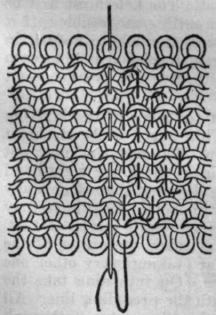
Due to the textile origin of the term tantra (from tan- 'to weave'), one might suggest the idea that it denoted at first the "texture" (note the same metaphor at work in "text") of a ritual, upon which successive rites could have been applied exactly as different kinds of weaving could be woven on the same rough warp.
Jan Gonda analogously emphasises the textile imagery on which this ritual terminology is based, by mentioning «the distinction between the ‘warp’ (tantra) and the ‘woof’ (āvāpa) of a sacrificial rite, that is of the framework, standing model, or those components which has in common with other rites and those that vary from ritual to ritual and are therefore the special characteristic features» (Gonda 1977:510).
Unfortunately, a lexica mention 'woof' as a possible meaning of āvāpa and the etymology supports it, I do not know of any attestation of āvāpa bearing this meaning if not in the context of a contrast to tantra.

How much does this pre-history influence the later history of tantra as "Sacred Text"?

On tantra, see here.

Monday, June 6, 2011

Post hoc, ergo propter hoc?

A typical fallacy in the doctrine of causality is to confound between what follows (post hoc) and what is caused by something (propter hoc). Extreme examples of this fallacy might be those leading to superstitions:

  • I had an accident after having seen a black cat, hence the black cat is the cause of my accident.
But there are many examples and David Hume even claimed that our notion of cause is ultimately grounded in such subtle cases: I see a seed and later a plant, hence I understand that the seed is the cause of a plant. But what I actually saw is only that the plant appeared after the seed.
I am inclined to think that nimitta in Mīmāmṣā is an (indirect) answer to this risk of fallacy. It refers to what must be there before the happening of something, but does not claim to be its cause. In other words, it designates the essential condition for something to occur. A nimitta is necessary for X to occur, but neither is X mechanically linked to it, nor nimitta to X.
In fact, nimitta in Mīmāṃsā primarily denotes the condition for the performance of a naimittika ritual. A typical example of such rituals is the jātakarman, to be performed after the birth of one's son. The birth of one's son is the nimitta for the ritual? Is it also its cause? Not really, since many of us had sons and have not performed any ritual.
Similarly, Mīmāṃsā author speak of nimitta in order to denote what must precede X for X to happen, but is not its cause.
Interestingly, nimitta is, instead, listed in Nyāyavaiśeṣika among the causes (kāraṇa), as the necessary cause in which the result does not inhere, e.g., the potter in the case of the pot.

Did Nyāyavaiśeṣika authors borrow it from its ritual usage?
And, more generally, did Indian authors distinguish between post hoc (after that) and propter hoc (because of that)?

Sunday, May 8, 2011

How to fix the meaning of a technical term, whose prehistory is unknown?

Ritual terminology has been fundamental in influencing the later development of philosophical terms in India. Several ritual terms have a textual origin (e.g., tantra 'warp', tati, from the root tan-, `to expand') and most of them are transparent (i.e., they can be analysed as derived from a certain root and a certain suffix). However, one has often the problem that such analyses are later than the terms themselves. Moreover, all these terms have frequently a pre-history we are not aware of, which might have influenced their historical meaning in an unpredictable way. Consider the case of tati and the following explanation in Gonda 1977, 510:
[…] pūrvā tatiḥ and uttarā tatiḥ "the antecedent and the subsequent series of ceremonies". The standard (ritual) is pūrva tatiḥ, and what one arranges (modifies) is uttarā tatiḥ; (for instance,) the establishment of the ritual fires is pūrvā tatiḥ, the re-establishment uttarā tatiḥ; of the vegetarian sacrifices (iṣṭi) the full and new moon sacrifices are the pūrvā tatiḥ, all the optional rites (kāmyā iṣṭayaḥ) the uttarā tatiḥ.
This seems to frame the uttara tati/pūrva tati distinction within the prakṛti/vikṛti one.

Further posts on Ritual Sūtras and on their world view: this one on the spatial arrangement of sacrifices; this one on tantra.

Sunday, April 10, 2011

Temporal and spatial arrangement

What delimits an abstract entity, like a sacrifice?
Indian thinkers were well aware of the fact that its outer spatial and temporal boundaries might have not been the same as its ideal boundaries. The end (anta) of a sacrifice was not necessarily the same as its completion and the sacrificer should be aware of it, in order to avoid reaching the temporal end of the sacrifice before having reached its completion.
The latter is called saṃsthā, which is an interesting term, meaning at the same time "completion" and "form". In later texts, each sacrifice may have more than one saṃsthā (form) and the various saṃsthā are distinguished because of their completing formulas. In the Śrauta Sūtras, the meaning of "completion" prevails. Lilian Silburn, in her well-known Instant et cause writes that
saṃsthā designates [perhaps because it delimits it] the very structure of the sacrifice (p.60).
Silburn further notes that saṃsthā is the temporal foundation of a sacrifice, whereas pratiṣṭhā is its spatial foundation (see also Thite, Sacrifice in the Brāhmaṇa-Texts, 1975: 274):

saṃsthā consists of a coordination of structures within time, [since] rūpa, the form, is considered to be tantamount to an activity (karman) (p.61).

It might be interesting to note that "temporal" refers to the dynamic aspect of the sacrifice, rather than to its diachronic dimension. The historical dimension of rituals and of their evolution is, by contrast, completely out of sight.

Saturday, April 9, 2011

Arranging the sacrifice in space

Mīmāṃsā, Grammar and Kalpasūtra share a common terminology and the more one looks at it, the better one realises how it reflects a spatial (and not temporal) organization of concepts (see these comments). Let me focus on one example.

According to Śabara and all subsequent Mīmāṃsakas, prasaṅga is the topic of 12. Its standard definitions in mature Mīmāṃsā run more or less as follows:
so ’yam anyārthānuṣṭhitāṅgair anyasyo ’pakārarūpaḥ prasaṅgo dvādaśa ucyate (MNS 12.1.1).
This is prasaṅga, which has the form of assistance for one thing by means of subsidiaries performed for the sake of another, and which is spoken of in the Twelfth Book ([Benson 2010, 766]).
In other words, prasaṅga refers to:
• a function
• which applies to more than one item
• insofar as it has been made for the purpose of one item, but then ends up helping another, too.

A further requirement, which is explicit in Śabara and only implicit in the above definition is an explicit prescription prescribing for a certain occurrence the assistance originally performed for a previous one. In fact, since the assistance which is given through prasaṅga is, unlike tantra, not necessary present insofar as it pertains to the structure of the rite, it is only through an explicit prescription that one understands that it is needed.
In other words, all elements prescribed in the context of the Darśapūrṇamāsa sacrifice apply through tantra to all the six rites composing it, independently of whether they are actually needed there, just because the six rite share the same basic procedure (another meaning of tantra). By contrast, the assistance offered through prasaṅga applies to a sacrifice different from the one it had been initially performed for. Therefore it only applies to this later sacrifice if it is explicitly needed there, i.e., if in the later sacrifice there is a prescription enjoining the
same assistance.
To summarize:
tantra | prasaṅga
structural | non structural
applies anyway | applies only if prescribed
same sacrifice |different sacrifice or rite

On tantra and prasaṅga, see here. On tantra and absence, see here. On tantra as a technical term, see here and here.

Monday, March 21, 2011

Sanskrit and English translations

tatra, tad, tataḥ… are among the most common Sanskrit words. A Sanskrit sentence easily runs like that:
A is B and B is C. tataḥ A is C

A literal English translation, such as:
A is B and B is C. For that reason, A is C

runs the risk to make readers ask "Which reason? One mentioned before?".
On the contrary, a standard English translation of it could be rather:
A is B and B is C. For this reason, A is C.

In other words, in English "that" is by far less common than "this" and so are "in that case", "for that reason", etc. The latter are only used to contrast, for instance, that case with this case, that reason with this reason. To put it short: "this" is the standard, non-connoted form. "That" is the connoted one.
Should we then translate tatra, tad… with "this"…, unless a contrast is highlighted through them? What strategies do readers use? (Or: Do they think that my grasp of English is too poor in this case?)

As for translations in general, see here and here.
As for the translation of specific terms, see here and under the labels "Sanskrit" and "koṣa".

Monday, December 20, 2010

Sanskrit Translations

What do we want to achieve with the translation of a Sanskrit term? Who are our target-readers? This seems to me to be the chief question while deciding about a translation. In fact, in many cases a translation ends up being understandable only to specialists.

A good example is, in my opinion, the translation of vyāpti, the invariable concomitance holding between the elements of an inference, e.g., between fire and smoke.
Vyāpti is a nomen actionis from the root vyāp-, which literally means 'to pervade'. Hence, many (most, I would say) authors translate vyāpti with 'pervasion'. This has almost become a terminus technicus in the works dedicated to Sanskrit logic. But is it a good choice? Is not it only understandable by an elite, which hence runs the risk to appear non-interested in communicating with any scholar outside itself?
To elaborate, 'pervasion' seems to me to be not-understandable for non-Sanskritists. It does not correspond to any logical term (as, instead, probans for hetu) in Western logic, nor is it intuitively understandable (as 'invariable concomitance' for vyāpti, which at least describes what is at stake). 'Pervasion' is just a literal translation of the Sanskrit term, which tries to reproduce the metaphor in English. Personally, I (and I suspect many others) only understand it, because I automatically translate it back into Sanskrit.

However, against 'invariable concomitance' Michael Williams (Manchester) made me aware of the fact that it does not point out that a vyāpti is not necessarily a commutable relationship. For instance, wherever there is smoke, there is necessarily fire, but it is not the case that wherever there is fire there is smoke. Indeed, according to the Ancient Indian Physics, there is fire in a piece of melting iron, though there is no smoke accompanying it.
Hence, one could use a paraphrase, such as "Smoke is invariably concomitant with fire", thus implying that the opposite is not necessarily the case.
Moreover, 'pervasion' is delusory also as for the 'direction' of the relationship. In the standard example, the point is that there is no smoke without fire. But, if one says that "Fire pervades smoke", does the listener understand that fire is a larger set than fire? Or does not s/he imagine fire 'permeating' (i.e., becoming diffused within) smoke, thus implying that smoke is a smaller set?

Thursday, May 13, 2010

Vedānta Deśika on śabdapramāṇa arguments for yogipratyakṣa

Vedānta Deśika's position in the Seśvaramīmāṃsā is quite complicated. As a Mīmāṃsaka author, he denies the possibility of ṛṣis who actually saw the dharma and then authored the Veda. As a theist, however, he assumes that this is possible in the case of God, Viṣṇu. The terms he uses in this connection are: śāstra, āgama, upadeśa, śruti. Śruti designates just the Veda (?). Śāstra designates the genuine Sacred Texts, i.e., the Veda and the Pañcarātra. Āgama refers to the Sacred Texts insofar as they have been uninterruptedly handed down. The same verbal root may apply, hence, also to non-śāstric texts, having a human origin, called upadeśa, which have also been handed down (presumably: since a very ancient time).

The Lord's perception of dharma can be trusted, because it is nitya. Hence, it has not been acquired, unlike in the case of ṛṣis or yogins. In fact, the previous arguments all pointed at the impossibility for a person to acquire such an extraordinary perception. They do not prove that such a perception cannot inhere forever in God.
Licenza Creative Commons
Quest' opera è distribuita con licenza Creative Commons Attribuzione - Non commerciale - Non opere derivate 2.5 Italia.