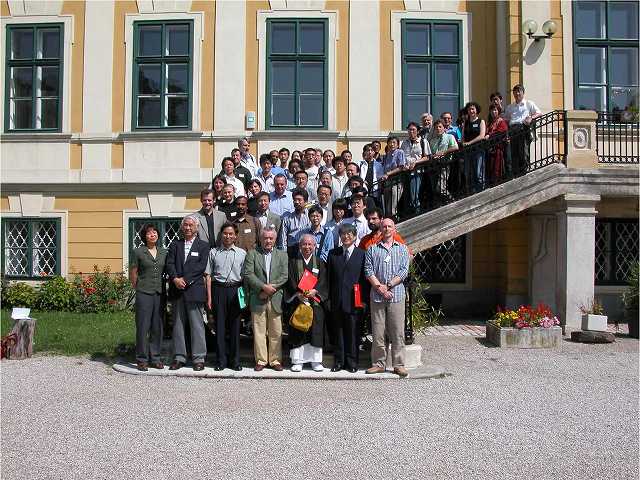
I virtually met Aleix many years ago, through his first blog (Fulla de Palma) and we soon became pen-friends until we met in person during a visit of mine in Cambridge, where he is studying for his PhD. He has since taken part to the Coffee Break Project (see here for his presentation at the next CBC in a few days) and to my volume on textual re-use. Thus, beside his achievements in both Pāli and Sanskrit I can add that I strongly recommend working with him (in case you are wondering, though being a non-conformist thinker and writer, Aleix is not an artist —he even let me edit the interview without correcting its final draft).
EF: What is your current project?ARF: I'm writing my PhD thesis in Cambridge, studying Pali grammars or grammatical commentaries written in Burma, ca. 11th-15th centuries AD.
EF: Then, let me ask you a question which goes way beyond political-correctness: Don't you ever get bored with your authors?
ARF: Yes and no, and I think the reason is the same. Yes, it's quite boring, because they say almost the same things, but no, because they say ALMOST, but not exactly, the same thing and I wonder why, and here's the gap I'm trying to fill, so to say.
EF: Do you mean that you try to understand the rationale beyond the small differences?ARF: More or less. I'm trying to understand, in the first place, why would they care writing these works, in the second why would they care about minor points that seem actually meaningless and finally there is another aspect, which is crucial, namely, 80% (approx.) of the Pali authors in medieval Burma were grammarians. They wrote, at least, one grammatical work.
Thus, grammar seems to be very important in Burmese Pali literature. The mainstream theory tries to explain it saying that the Burmese people were not familiar with Pali, that is was a foreign language, etc. But I'm not sure…
EF: If this were the case: why would they bother about grammar? Grammar is not for the purpose of learning the language, but for speculating about it. I would say that Grammar : language = Mīmāṃsā : ritual. You do not need to reflect about the ritual in order to be able to perform it, just like you do not need to reflect about language in order to understand it… not to mention in order to speak it.
So, what is your theory about the pre-eminence of Grammar in Burma?ARF: well, it goes in the lines of what you said about Mīmāṃsā, but there is an important historical aspect that I am also trying to understand better. My thesis, in short, is that grammar was what Theravādins call pariyatti. Let me put it in other words, in post-canonical Pāli we have handbooks for different disciplines: handbooks that summarize the Abhidhamma, handbooks that summarize the Vinaya, meditation manuals…I think that grammatical handbooks are the equivalent for the Sutta literature, that is, they are the exegetical tools in order to study the Suttantas or discourses of the Buddha.
EF: Thus, they were not for the purpose of learning Pali, but for the purpose of understanding the Buddha's word?ARF: I think I would go beyond that. I would say that they focused on grammar because Pali, as a language, is the substance of the Tipiṭaka, so to say. And as I said before there is a historical context that matters a lot because Theravāda Buddhism was not the only religion in Burma, even though people think Burma has been always like today.
In the 12-13th centuries, for instance, there were competing Mahāyāna sects, other sects within Hināyāna, Vaiṣṇavism and Animism etc.
EF: Are you saying that the focus on Pāli was a sort of lakṣaṇa (distinctive mark) for Theravāda and that the role of Grammar has to be understood accordingly?ARF: Exactly, they gave preeminence to pariyatti, that is, textual-based religion (this is something I'm studying now, as part of my PhD). And it's funny how the story (or history) repeats itself today. I was recently in Burma/Myanmar and discussed this topic with a monk, who told me that recently the Myanmar government passed a bill forcing preacher-monks to hold, at least, the Dhammacariya degree (i.e., a BA in Theravada studies).
EF: That is, you are not allowed to be an illiterate monk?ARF: More or less. The point is that, seemingly, there were some preachers who were preaching "their own ideas in Burmese". Usually, the preacher says some canonical words in Pāli and then gives an explanation in Burmese, but these monks did not know Pāli. This happened nowadays, but if we trust the chronicles (which is not very advisable sometimes) a similar thing happened in the 12th century with some forms of tantrism.
EF: Do you mean that the emphasis on Pali is a way to rule out heterodoxies?ARF: Exactly. The knowledge of Pāli is an objective parameter and can serve as a sort of touchstone to distinguish real from fake.
EF: This leads me to a second point: some Sanskritists tend to see (although they would not admit it openly) Pāli as a low-level Sanskrit and Pāli texts as a lower order śāstra. Given that you read both Sanskrit and Pāli, when you read Pāli Grammarians do you feel they are "as sophisticated as" Sanskrit ones or just "different" (due to their different concerns)?ARF: They are as sofisticated as Sanskrit grammarians, if only because they copy them…
EF: For instance, while I was reading your paper on the gender of go at a certain point I found myself thinking "They are complicating a simple issue… if only they could resort to the Skt solution…".ARF: Oh, yes, but let me explain that the main point of that paper was precisely that Pāli grammarians see Pāli as a corpus of sacred scriptures and they have no other authority to decide about them than the text. Thus, the text itself is its own grammatical authority. It is paradoxical.
EF: I would not say it is a paradox: it is the same when we reconstruct the grammar of a dead language, and of a spoken one, if the speakers themselves become the authorities.ARF: Not so. If you are using modern linguistics, you could resort to comparisons, but Pāli grammarians did not compare, for instance, Pāli with Ardhamāgadhī.
EF: I see. There is no external authority in the case of Pāli Grammar.ARF: Exactly. And there are some interesting discussions about the way the Buddha talked. There are two axioms or premises that we need to take into account here. Premise No. one: the Tipiṭaka is the word of the Buddha, meaning, more or less, that he said all what is said there. Premise No. two: Pali, i.e. Māgadhī, is the root language of all beings. So if you have a baby and don't teach her to talk, she will naturally start to talk Pāli.
Indeed Vimalabuddhi, a 10th c. Pāli grammarian, says in a very interesting passage that Pāli was there before the Buddha appeared in the world, and he says something strange, namely (I'm quoting from memory) "this happens in every Buddha-field". Thus, Pāli is much more than just the language in which the Buddha uttered the texts of the Tipiṭaka. It is like a primordial language.
EF: I see. Similar to what is said about Sanskrit (cf. the Paspaśā's discussion about apaśabdas, being able to communicate a meaning only because one infers the Sanskrit form out of them), but with this additional historical perspective.
ARF: Yes. And who knows what Vimalabuddhi in the 10th century or Aggavamsa in the 12th century would have thought of ancient Magadha. It was for them like talking about the beginning of the world…And I think that this explains, in a way, the counting of years from the Buddha's parinirvāṇa. As if the world, our world, begins at that point.
But there are some additional elements to be taken into account in this reconstruction. First: in the Pāli texts we have records or mentions of other dialects in northern India. Second: Aggavamsa says that the bodhisatta, through hundreds of thousands existences learnt Pāli. Thus, Pāli was there during all these years. So, why would it disappear after the Buddha? (Since, at least, it had disappeared in the 12th century AD).
EF: But did they think that it had disappeared? Did not they think that it was still a reality (given that you write that they wrote in Pāli and that it was a sort of lingua franca for the Theravāda world)?ARF: I don't recall reading about this topic in grammars, it might be dealt with in Buddhaghosa's accounts of the history of the teaching, I cannot say now. But there is the certainty that Pāli is a language of the past. It is not the language of Sri Lanka, nor the language of Burma and I don't know if they still identified Pali with a northern Indian dialect.
I recently read an article suggesting that Aggavamsa, the author of the Pāli grammar Saddaniti, visited Bodhgaya. Unfortunately, it didn't occur to him to write a travelogue.
Enjoyed this interview? Then be ready to read the next part on my new blog, where I will discuss with Aleix of philosophy and South Asian studies. You can read another interview here.
And you can suggest further questions for the next interviews by commenting here.
EF: What is your current project?ARF: I'm writing my PhD thesis in Cambridge, studying Pali grammars or grammatical commentaries written in Burma, ca. 11th-15th centuries AD.
EF: Then, let me ask you a question which goes way beyond political-correctness: Don't you ever get bored with your authors?
ARF: Yes and no, and I think the reason is the same. Yes, it's quite boring, because they say almost the same things, but no, because they say ALMOST, but not exactly, the same thing and I wonder why, and here's the gap I'm trying to fill, so to say.
EF: Do you mean that you try to understand the rationale beyond the small differences?ARF: More or less. I'm trying to understand, in the first place, why would they care writing these works, in the second why would they care about minor points that seem actually meaningless and finally there is another aspect, which is crucial, namely, 80% (approx.) of the Pali authors in medieval Burma were grammarians. They wrote, at least, one grammatical work.
Thus, grammar seems to be very important in Burmese Pali literature. The mainstream theory tries to explain it saying that the Burmese people were not familiar with Pali, that is was a foreign language, etc. But I'm not sure…
EF: If this were the case: why would they bother about grammar? Grammar is not for the purpose of learning the language, but for speculating about it. I would say that Grammar : language = Mīmāṃsā : ritual. You do not need to reflect about the ritual in order to be able to perform it, just like you do not need to reflect about language in order to understand it… not to mention in order to speak it.
So, what is your theory about the pre-eminence of Grammar in Burma?ARF: well, it goes in the lines of what you said about Mīmāṃsā, but there is an important historical aspect that I am also trying to understand better. My thesis, in short, is that grammar was what Theravādins call pariyatti. Let me put it in other words, in post-canonical Pāli we have handbooks for different disciplines: handbooks that summarize the Abhidhamma, handbooks that summarize the Vinaya, meditation manuals…I think that grammatical handbooks are the equivalent for the Sutta literature, that is, they are the exegetical tools in order to study the Suttantas or discourses of the Buddha.
EF: Thus, they were not for the purpose of learning Pali, but for the purpose of understanding the Buddha's word?ARF: I think I would go beyond that. I would say that they focused on grammar because Pali, as a language, is the substance of the Tipiṭaka, so to say. And as I said before there is a historical context that matters a lot because Theravāda Buddhism was not the only religion in Burma, even though people think Burma has been always like today.
In the 12-13th centuries, for instance, there were competing Mahāyāna sects, other sects within Hināyāna, Vaiṣṇavism and Animism etc.
EF: Are you saying that the focus on Pāli was a sort of lakṣaṇa (distinctive mark) for Theravāda and that the role of Grammar has to be understood accordingly?ARF: Exactly, they gave preeminence to pariyatti, that is, textual-based religion (this is something I'm studying now, as part of my PhD). And it's funny how the story (or history) repeats itself today. I was recently in Burma/Myanmar and discussed this topic with a monk, who told me that recently the Myanmar government passed a bill forcing preacher-monks to hold, at least, the Dhammacariya degree (i.e., a BA in Theravada studies).
EF: That is, you are not allowed to be an illiterate monk?ARF: More or less. The point is that, seemingly, there were some preachers who were preaching "their own ideas in Burmese". Usually, the preacher says some canonical words in Pāli and then gives an explanation in Burmese, but these monks did not know Pāli. This happened nowadays, but if we trust the chronicles (which is not very advisable sometimes) a similar thing happened in the 12th century with some forms of tantrism.
EF: Do you mean that the emphasis on Pali is a way to rule out heterodoxies?ARF: Exactly. The knowledge of Pāli is an objective parameter and can serve as a sort of touchstone to distinguish real from fake.
EF: This leads me to a second point: some Sanskritists tend to see (although they would not admit it openly) Pāli as a low-level Sanskrit and Pāli texts as a lower order śāstra. Given that you read both Sanskrit and Pāli, when you read Pāli Grammarians do you feel they are "as sophisticated as" Sanskrit ones or just "different" (due to their different concerns)?ARF: They are as sofisticated as Sanskrit grammarians, if only because they copy them…
EF: For instance, while I was reading your paper on the gender of go at a certain point I found myself thinking "They are complicating a simple issue… if only they could resort to the Skt solution…".ARF: Oh, yes, but let me explain that the main point of that paper was precisely that Pāli grammarians see Pāli as a corpus of sacred scriptures and they have no other authority to decide about them than the text. Thus, the text itself is its own grammatical authority. It is paradoxical.
EF: I would not say it is a paradox: it is the same when we reconstruct the grammar of a dead language, and of a spoken one, if the speakers themselves become the authorities.ARF: Not so. If you are using modern linguistics, you could resort to comparisons, but Pāli grammarians did not compare, for instance, Pāli with Ardhamāgadhī.
EF: I see. There is no external authority in the case of Pāli Grammar.ARF: Exactly. And there are some interesting discussions about the way the Buddha talked. There are two axioms or premises that we need to take into account here. Premise No. one: the Tipiṭaka is the word of the Buddha, meaning, more or less, that he said all what is said there. Premise No. two: Pali, i.e. Māgadhī, is the root language of all beings. So if you have a baby and don't teach her to talk, she will naturally start to talk Pāli.
Indeed Vimalabuddhi, a 10th c. Pāli grammarian, says in a very interesting passage that Pāli was there before the Buddha appeared in the world, and he says something strange, namely (I'm quoting from memory) "this happens in every Buddha-field". Thus, Pāli is much more than just the language in which the Buddha uttered the texts of the Tipiṭaka. It is like a primordial language.
EF: I see. Similar to what is said about Sanskrit (cf. the Paspaśā's discussion about apaśabdas, being able to communicate a meaning only because one infers the Sanskrit form out of them), but with this additional historical perspective.
ARF: Yes. And who knows what Vimalabuddhi in the 10th century or Aggavamsa in the 12th century would have thought of ancient Magadha. It was for them like talking about the beginning of the world…And I think that this explains, in a way, the counting of years from the Buddha's parinirvāṇa. As if the world, our world, begins at that point.
But there are some additional elements to be taken into account in this reconstruction. First: in the Pāli texts we have records or mentions of other dialects in northern India. Second: Aggavamsa says that the bodhisatta, through hundreds of thousands existences learnt Pāli. Thus, Pāli was there during all these years. So, why would it disappear after the Buddha? (Since, at least, it had disappeared in the 12th century AD).
EF: But did they think that it had disappeared? Did not they think that it was still a reality (given that you write that they wrote in Pāli and that it was a sort of lingua franca for the Theravāda world)?ARF: I don't recall reading about this topic in grammars, it might be dealt with in Buddhaghosa's accounts of the history of the teaching, I cannot say now. But there is the certainty that Pāli is a language of the past. It is not the language of Sri Lanka, nor the language of Burma and I don't know if they still identified Pali with a northern Indian dialect.
I recently read an article suggesting that Aggavamsa, the author of the Pāli grammar Saddaniti, visited Bodhgaya. Unfortunately, it didn't occur to him to write a travelogue.
Enjoyed this interview? Then be ready to read the next part on my new blog, where I will discuss with Aleix of philosophy and South Asian studies. You can read another interview here.
And you can suggest further questions for the next interviews by commenting here.